Presentation Details
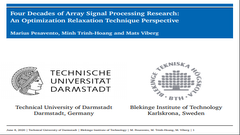
Four Decades of Array Signal Processing Research: An Optimization Relaxation Technique Perspective
Start Time:Pending(Asia/Shanghai)
Duration:Pending
Session:No Session »
Tips: Only the registered participant can access the file. Please sign in first.
Abstract
Keywords
Speaker
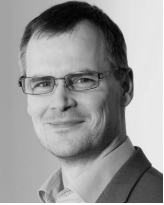
Pesavento Marius
Communication Systems Group;Technische Universitat DarmstadtMarius Pesavento received the Dipl.-Ing. degree in 1999 and the Dr.-Ing. degree in electrical engineering in 2005, both from Ruhr-University Bochum, Bochum, Germany, and the M.Eng. degree from McMaster University, Hamilton, ON, Canada, in 2000. Between 2005 and 2009, he held research positions in two start-up companies. In 2010, he became an Assistant Professor for robust signal processing and a Full Professor for communication systems in 2013 with the Department of Electrical Engineering and Information Technology, Technical University Darmstadt, Darmstadt, Germany.
His research interests include robust signal processing and adaptive beamforming, high-resolution sensor array processing, multiantenna and multiuser communication systems, distributed, sparse, and mixed-integer optimization techniques for signal processing and communications, statistical signal processing, spectral analysis, and parameter estimation. He served as an Associate Editor for the IEEE Transactions on Signal Processing during 2012–2016 and is currently a member of the Editorial Board of the EURASIP Signal Processing Journal. He is a member of the Sensor Array and Multichannel Technical Committee of the IEEE Signal Processing Society and the Special Area Teams Signal Processing for Communications and Networking and Signal Processing for Multisensor Systems of the EURASIP. He is the recipient of the 2003 ITG/VDE Best Paper Award, the 2005 Young Author Best Paper Award of the IEEE Transactions On Signal Processing, and the 2010 Best Paper Award of the CrownCOM Conference.

Trinh Hoang Minh
Communication Systems Group;Technische Universitat DarmstadtMinh Trinh-Hoang received the M.Sc. degree in electrical engineering in 2017 from Technical University Darmstadt, Darmstadt, Germany, where he is currently working toward the Ph.D degree. His research interests include statistical signal processing, array processing, and numerical computation.

Mats Viberg
Blekinge Institute of TechnologyMats Viberg received the M.Sc. degree in applied mathematics in 1985 and the Ph.D. degree in automatic control from Linköping University, Linköping, Sweden, in 1989.
Dr. Viberg has served in various capacities in the IEEE Signal Processing Society, including the Chair with the Technical Committees on Signal Processing Theory and Methods and Sensor Array and Multichannel Signal Processing as well as member at large with the Board of Governors. He has also served in various capacities with the Swedish Research Council (VR). He was the recipient of the two paper awards from the IEEE Signal Processing Society, the Excellent Research Award from the VR, and the EURASIP European Group Technical Achievement Award. He is a member of the Royal Swedish Academy of Sciences and the Royal Society of Arts and Sciences in Gothenburg, Sweden.
All Comments
Important Date
-
Conference Date
Jun 08
2020
toJun 11
2020
-
Jan 12 2020
Draft paper submission deadline
-
Apr 15 2020
Early Bird Registration
-
Dec 31 2020
Registration deadline
Sponsored By
Organized By
Contact Information
- Prof. Zhiguo Shi
- zj******@gmail.com
Previous Conferences

Submit Comment