Presentation Details
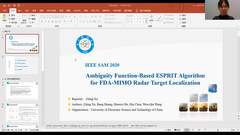
Ambiguity Function-Based ESPRIT Algorithm for FDA-MIMO Radar Target Localization
ID:52
View Protection:ATTENDEE
Updated Time:2020-08-05 10:17:00 Hits:1023
Oral Presentation
Start Time:2020-06-09 14:20(Asia/Shanghai)
Duration:20min
Session:R Regular Session »
Video
No Permission
Tips: Only the registered participant can access the file. Please sign in first.
Abstract
Frequency-diverse array (FDA) can provide a range-angle-time dependent beamforming capability that could make a difference in some radar applications. However, the joint range-angle estimation of FDA will inevitably increase the complexity
due to the coupling of range and angle. Estimation of signal parameters via rotational invariance techniques (ESPRIT) algorithm cannot be used directly to estimate the angle and range because it does not meet the rotation invariance criterion. In this paper, an Ambiguity function (AF)-based method is proposed to
avoid the coupling of range and angle for the FDA and multiple-input multiple-output (MIMO) combined radar to realize high-resolution range and angle estimation. Numerical results show its advantages over TLS-ESPRIT method.
Keywords
Ambiguity function; frequency diverse array; multiple-input multiple-output
Speaker

Ziting Xu
University of Electronic Science and Technology of China, ChinaSubmission Author
All Comments
Important Date
-
Conference Date
Jun 08
2020
toJun 11
2020
-
Jan 12 2020
Draft paper submission deadline
-
Apr 15 2020
Early Bird Registration
-
Dec 31 2020
Registration deadline
Sponsored By
IEEE Signal Processing Society
Organized By
Zhejiang University
Contact Information
- Prof. Zhiguo Shi
- zj******@gmail.com
Previous Conferences

Submit Comment