Presentation Details
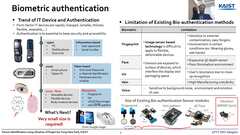
Person identification utilizing vibration response of human fingers
Start Time:Pending(Asia/Shanghai)
Duration:Pending
Session:No Session »
Tips: Only the registered participant can access the file. Please sign in first.
Abstract
Keywords
Speaker

Yong-Hwa Park
Professor KAISTYong-Hwa Park received BS, MS, and PhD in Mechanical Engineering from KAIST in 1991, 1993, and 1999, respectively. In 2000-2003, he joined to Aerospace Department in University of Colorado at Boulder as a research associate. In 2003-2016, he worked for Samsung Electronics in Visual Display Division and Samsung Advanced Institute of Technology (SAIT) as a Research Master in the field of vibrating micro-opto-electro-mechanical systems with applications to 3D imaging, health sensors and display systems. From 2016, he joined to KAIST as an associate professor of NOVIC+ (Noise & Vibration Control Plus) at the department of Mechanical Engineering devoting to researches on vibration, acoustics, vision sensors and AI-based recognitions for human-machine interactions. His research fields include structural vibration; system identification; event detection and condition monitoring from vibration and acoustic signatures utilizing AI; blood pressure and health monitoring sensors; and 3D/lidar sensors for vibration measurements. He has been working for SPIE Photonics West as a conference chair of MOEMS and miniaturized systems since 2013. He is a board member of KSME, KSNVE, KSPE, and SPIE. He works for KSME as an associated editor.
Submission Author
All Comments
Important Date
-
Conference Date
Nov 01
2022
toNov 03
2022
-
Oct 30 2022
Draft paper submission deadline
-
Nov 09 2022
Registration deadline
Sponsored By
Contact Information
- Miss T. Yuan
- se******@apvc2021.org

Submit Comment