Presentation Details
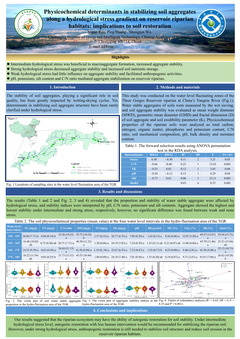
Physicochemical determinants in stabilizing soil aggregates along a hydrological stress gradient on reservoir riparian habitats: implications to soil restoration
ID:2705
View Protection:ATTENDEE
Updated Time:2021-07-05 22:19:08
Hits:2212
Poster Presentation
Start Time:2021-07-10 08:20(Asia/Shanghai)
Duration:5min
Session:SP 张贴报告专场 »
Abstract
The stability of soil aggregates, playing a significant role in soil quality, has been greatly impacted by wetting-drying cycles. Yet, determinants in stabilizing soil aggregate structure have been rarely clarified under hydrological stress. Therefore, under the hydrological stress, this study evaluated the relative importance of soil physicochemical properties in stabilizing soil aggregates on water level fluctuating zones of the Three Gorges Reservoir riparian at China’s Yangtze River. Water stable aggregates of soils (large macroaggregates: > 2 mm, small macroaggregates: 0.25 ~ 2 mm, microaggregates: 0.053 ~ 0.25 mm, silt - and clay - sized aggregates: 0 ~ 0.053 mm) were measured by the wet sieving, and soil aggregate stability was evaluated as mean weight diameter (MWD), geometric mean diameter (GMD) and fractal dimension (D) of soil aggregate and soil erodibility parameter (K). Physicochemical properties of the riparian soils were analyzed as total carbon, nitrogen, organic matter, phosphorus and potassium content, C/N ratio, soil mechanical composition, pH, bulk density and moisture content. The results indicated that soil total carbon, nitrogen, organic matter, phosphorus and potassium were highly concentrated in the areas under strong hydrological stress; the pH was mainly alkalinity, pH value and bulk density both decreased along the incremental stress gradient. The findings revealed that the proportion and stability of water stable aggregate were affected by hydrological stress, and stability indices were interpreted by pH, C/N ratio, potassium and silt contents. Aggregate showed the highest and lowest stability under intermediate and strong stress, respectively, however, no significant difference was found between weak and none stress. Finally, our results suggested that the riparian ecosystem may have the ability of autogenic restoration for soil stability. Under intermediate hydrological stress level, autogenic restoration with less human intervention would be recommended for stabilizing the riparian soil. However, under strong hydrological stress, anthropogenic restoration is still needed to stabilize soil structure and reduce soil erosion in reservoir riparian habitats.
Keywords
Aggregate stability;Hydrological stress;Mean weight diameter;Soil restoration
Speaker

冉义国
助理研究员 中国科学院重庆绿色智能技术研究院Submission Author
All Comments
Important Date
-
Conference Date
Jul 09
2021
toJul 11
2021
-
May 30 2021
Abstract Submission Deadline
-
May 30 2021
Draft paper submission deadline
-
May 30 2021
Early Bird Registration
-
Jul 10 2021
Registration deadline
-
Jul 11 2021
Contribution Submission Deadline
Sponsored By
青年地学论坛理事会
Organized By
中国科学院地球化学研究所
贵州大学
贵州大学
Contact Information

Submit Comment