Presentation Details
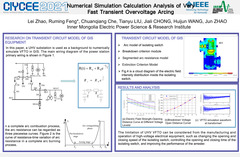
Numerical Simulation Calculation Analysis of Very Fast Transient Overvoltage Arcing
ID:131
View Protection:ATTENDEE
Updated Time:2021-12-10 16:30:23
Hits:963
Poster Presentation
Start Time:2021-12-17 14:35(Asia/Shanghai)
Duration:5min
Session:Z Poster Session »
Video
No Permission
Presentation File
Tips: Only the registered participant can access the file. Please sign in first.
Abstract
In gas insulated substation (GIS), very fast transient over-voltage (VFTO) is caused during the switching operation because of repeated arc reignition. At present only the first arc is considered for numerical simulation of VFTO, which can’t describe the character of VFTO exactly, because the time of arc reignition and extinction is difficult to determine. Base on arc dynamic energy equation, the paper confirms the decision condition of arc reignition and extinction, and gets VFTO wave and peak voltage of each node during arc reignition by simulating. Comparing to the two results, it could see that, for the same node, there was not great change in wave forms; the VFTO maximums both on mains side of switching, also this node’s peak voltage had the largest difference, base on the first arc peak voltage, approximately 10.78%, which should been attention to for insulation of apparatus.
Keywords
GIS; Very fast transient over-voltage; Breakdown voltage of dielectrics; Arc reignition
Speaker

Ruming FENG
Inner Mongolia Power (Group) Co.,Ltd., Inner Mongolia Power Research Institute BranchSubmission Author
All Comments
Important Date
-
Conference Date
Jul 11
2023
toAug 18
2023
-
Nov 10 2021
Draft paper submission deadline
-
Dec 10 2021
Registration deadline
-
Dec 11 2021
Contribution Submission Deadline
Sponsored By
IEEE IAS
Organized By
IEEE IAS Student Chapter of Southwest Jiaotong University (SWJTU)
IEEE IAS Student Chapter of Huazhong University of Science and Technology (HUST)
IEEE PELS (Power Electronics Society) Student Chapter of HUST
IEEE IAS Student Chapter of Huazhong University of Science and Technology (HUST)
IEEE PELS (Power Electronics Society) Student Chapter of HUST
Contact Information
Previous Conferences
-
2026-10-29 China Wuhan
China International Youth Conference on Electrical Engineering -
2025-11-07 China Chengdu
China International Youth Conference on Electrical Engineeing -
2025-11-07 China Chengdu
2025 IEEE China International Youth Conference on Electrical Engineering (CIYCEE) -
2024-11-06 China Wuhan
China International Youth Conference on Electrical Engineering (CIYCEE 2024) -
2023-12-08 China Chengdu
4th China International Youth Conference on Electrical Engineering -
2023-12-08 China Chengdu
2023 IEEE 4th China International Youth Conference On Electrical Engineering (CIYCEE) -
2022-11-03 China Wuhan
2022 IEEE 3rd China International Youth Conference on Electrical Engineering -
2020-11-02 China Wuhan
China International Youth Conference on Electrical Engineering

Submit Comment