Presentation Details
High Temperature Characteristics of Composite Materials Composed of Silicone Gel and Barium Titanate
ID:135
View Protection:ATTENDEE
Updated Time:2021-12-03 10:41:43 Hits:964
Oral Presentation
Start Time:2021-12-15 15:00(Asia/Shanghai)
Duration:15min
Session:D High voltage and insulation technology »
Video
No Permission
Presentation File
Tips: Only the registered participant can access the file. Please sign in first.
Abstract
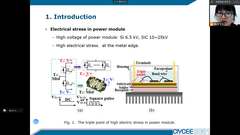
The blocking voltage of silicon carbide (SiC) devices is higher than 10 kV, and the temperature resistance is higher than 200 ℃. High voltage can cause high electric stress inside power modules. Increasing the insulation ability of the encapsulation material of SiC power module becomes an urgent requirement. The electrical field-dependent permittivity (FDP) material can be used to release the high electric stress. In this paper, by preparing the FDP composite material composed of silicone gel and barium titanate, the relationships between the permittivity and frequency of the material at different temperatures are studied. By analyzing the dielectric properties of the composite material under high temperature and high voltage, the advantages and disadvantages of using FDP material to reduce the electric field stress in power module are investigated.
Keywords
High voltage power modules, high temperature performance, permittivity, release electric stress, silicone gel
Speaker

Feifei Yan
Xi'An Jiaotong UniversitySubmission Author
All Comments
Important Date
-
Conference Date
Jul 11
2023
toAug 18
2023
-
Nov 10 2021
Draft paper submission deadline
-
Dec 10 2021
Registration deadline
-
Dec 11 2021
Contribution Submission Deadline
Sponsored By
IEEE IAS
Organized By
IEEE IAS Student Chapter of Southwest Jiaotong University (SWJTU)
IEEE IAS Student Chapter of Huazhong University of Science and Technology (HUST)
IEEE PELS (Power Electronics Society) Student Chapter of HUST
IEEE IAS Student Chapter of Huazhong University of Science and Technology (HUST)
IEEE PELS (Power Electronics Society) Student Chapter of HUST
Contact Information
Previous Conferences
-
2026-10-29 China Wuhan
China International Youth Conference on Electrical Engineering -
2025-11-07 China Chengdu
China International Youth Conference on Electrical Engineeing -
2025-11-07 China Chengdu
2025 IEEE China International Youth Conference on Electrical Engineering (CIYCEE) -
2024-11-06 China Wuhan
China International Youth Conference on Electrical Engineering (CIYCEE 2024) -
2023-12-08 China Chengdu
4th China International Youth Conference on Electrical Engineering -
2023-12-08 China Chengdu
2023 IEEE 4th China International Youth Conference On Electrical Engineering (CIYCEE) -
2022-11-03 China Wuhan
2022 IEEE 3rd China International Youth Conference on Electrical Engineering -
2020-11-02 China Wuhan
China International Youth Conference on Electrical Engineering

Submit Comment