Presentation Details
Analysis on a Novel Eddy current - magnet track composite brake for high-speed train
ID:317
View Protection:ATTENDEE
Updated Time:2022-05-20 08:55:16
Hits:291
Poster Presentation
Start Time:Pending(Asia/Shanghai)
Duration:Pending
Session:No Session »
Video
No Permission
Presentation File
Tips: Only the registered participant can access the file. Please sign in first.
Abstract
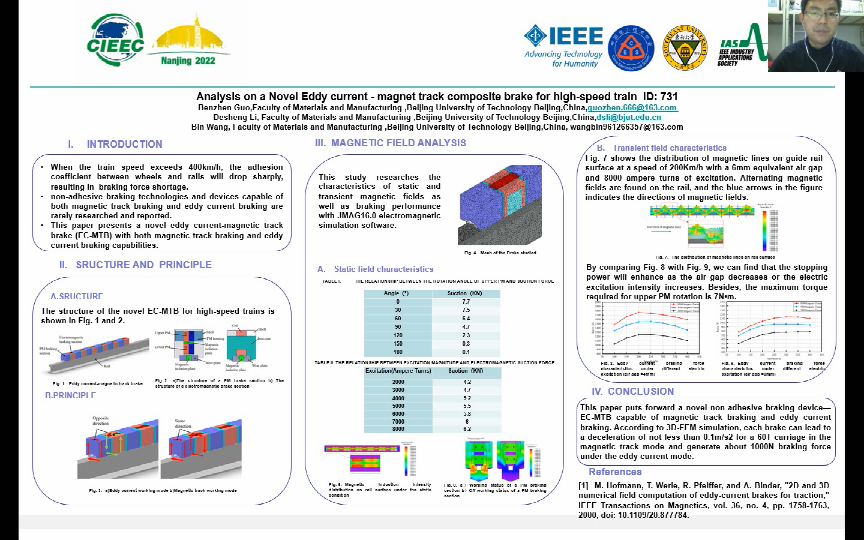
A novel eddy current-magnetic track composite brake (EC-MTB) for high-speed trains is first proposed in this paper. As a non-adhesive braking device, the brake can effectively make up for braking force shortage resulted by adhesion coefficient decrease of a high-speed train. The brake, consisting of alternating permanent magnet (PM) braking sections and electromagnetic braking sections, can work under eddy current braking and magnetic track braking modes. The function of excitation can be turned on and off by rotating the upper PM in the PM brake. Alternating or isotropic magnetic fields can be generated on the rail by changing the current direction in the electromagnetic brake. The paper firstly introduces the structure and working principle of the composite brake and then investigates characteristics of static and transient magnetic fields as well as braking performance through 3D finite element simulation(3D-FEM), which proves that the brake can lead to a deceleration of not less than 0.1m/s2 for a 60T carriage in the magnetic track mode and generate around 1000N braking force under the eddy current mode.
Keywords
eddy current; magnetic track; composite brake; high-speed train.
Speaker

GuoBenzhen
Beijing University of TechnologyAll Comments
Important Date
-
Conference Date
May 27
2022
toMay 29
2022
-
Feb 28 2022
Draft paper submission deadline
-
May 29 2022
Registration deadline
-
Jun 22 2022
Contribution Submission Deadline
Sponsored By
IEEE Beijing Section
China Electrotechnical Society
Southeast University
China Electrotechnical Society
Southeast University
Supported By
IEEE Industry Applications Society
IEEE Nanjing Section
IEEE Nanjing Section
Contact Information
- Organizing Committee
- ch******@ces.org.cn
- +86********
Previous Conferences
-
2026-05-15 China Tianjin
2026 IEEE 9th International Electrical and Energy Conference (CIEEC) -
2025-05-16 China Changsha
2025 IEEE 8th International Electrical and Energy Conference -
2024-05-10 China Harbin
2024 IEEE 7th International Electrical and Energy Conference (CIEEC) -
2023-05-12 China Hefei
2023 IEEE 6th International Electrical and Energy Conference -
2022-05-27 China
2022 年电气电子工程师学会电力与能源分会(IEEE PES)年会 -
2021-05-28 China Wuhan
2021 IEEE 4th International Electrical and Energy Conference -
2018-11-04 China
2018 IEEE 2nd International Electrical and Energy Conference -
2017-10-25 China 东城区
2017 China International Electrical and Energy Conference

Submit Comment