Presentation Details
Research on the characteristics of corona discharge ionic wind of needle-to-plate electrode
ID:593
View Protection:ATTENDEE
Updated Time:2022-05-22 18:04:13
Hits:481
Poster Presentation
Start Time:Pending(Asia/Shanghai)
Duration:Pending
Session:No Session »
Video
No Permission
Presentation File
Tips: Only the registered participant can access the file. Please sign in first.
Abstract
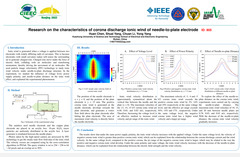
The ionic wind has been widely used in many fields because of its characteristics of no rotating parts, low noise, and low energy consumption. In this paper, the needle-plate electrode structure is used to study the effects of different voltage levels, different power supply polarities, and different needle-plate distances on the corona ionic wind characteristics through particle image velocimetry (PIV) technology, and the possible mechanism behind the experimental phenomenon is discussed. The research results show that under the same power supply polarity, the ionic wind velocity increases with the applied voltage. Under the same voltage level, the wind velocity and jet range of the negative corona ionic wind are greater than those of the positive corona. Under the same polarity and the same voltage level, the ionic wind velocity increases with the decrease of the needle-to-plate distance. The research results of this paper have certain guiding significance for improving the ionic wind velocity and further understanding the development process of ionic wind.
Keywords
corona discharge;ionic wind;PIV;wind velocity
Speaker

HuanChen
Huazhong University of Science and TechnologyAll Comments
Important Date
-
Conference Date
May 27
2022
toMay 29
2022
-
Feb 28 2022
Draft paper submission deadline
-
May 29 2022
Registration deadline
-
Jun 22 2022
Contribution Submission Deadline
Sponsored By
IEEE Beijing Section
China Electrotechnical Society
Southeast University
China Electrotechnical Society
Southeast University
Supported By
IEEE Industry Applications Society
IEEE Nanjing Section
IEEE Nanjing Section
Contact Information
- Organizing Committee
- ch******@ces.org.cn
- +86********
Previous Conferences
-
2026-05-15 China Tianjin
2026 IEEE 9th International Electrical and Energy Conference (CIEEC) -
2025-05-16 China Changsha
2025 IEEE 8th International Electrical and Energy Conference -
2024-05-10 China Harbin
2024 IEEE 7th International Electrical and Energy Conference (CIEEC) -
2023-05-12 China Hefei
2023 IEEE 6th International Electrical and Energy Conference -
2022-05-27 China
2022 年电气电子工程师学会电力与能源分会(IEEE PES)年会 -
2021-05-28 China Wuhan
2021 IEEE 4th International Electrical and Energy Conference -
2018-11-04 China
2018 IEEE 2nd International Electrical and Energy Conference -
2017-10-25 China 东城区
2017 China International Electrical and Energy Conference

Submit Comment