Presentation Details
Safety boundary analysis for lithium-ion batteries via overcharge-to-thermal runaway
ID:91
View Protection:ATTENDEE
Updated Time:2022-05-16 09:39:45
Hits:354
Poster Presentation
Start Time:Pending(Asia/Shanghai)
Duration:Pending
Session:No Session »
Abstract
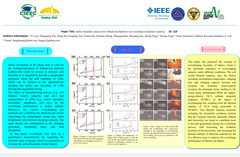
Acquiring the safe boundary of battery is beneficial to the safety risk evaluation of power battery and to offer the early warning signs. The method to accurately measure the overcharging capacity was studied, and it was verified through the overcharging test of three types of batteries (ca. 55 Ah) with different energy densities (250, 280, and 300 Wh·kg-1). Additionally, accelerating rate calorimetry test was conducted to study the self-heating behavior of cells under the adiabatic conditions. The effects of active materials and overcharging current on the safety performance of batteries were given. The safety performance of battery with energy density of 280 Wh·kg-1 is worse than that of 250 Wh·kg-1 with the same cathode materials, due to the dominant factor of the 7.6% higher cell capacity. Meanwhile, the LiNi0.8Co0.15Al0.05O2(LCA) cathode material with higher energy density shows better overcharging performance than the LiNi0.8Co0.1Mn0.1O2(LCM811) cathode material, which shows that LCA has a preferable thermal stability. Moreover, it is found that increasing the oxidation potential of the electrolyte and increasing the thermal stability of electrode material are the two effective ways to improve the overcharge performance of lithium-ion battery.
Acquiring the safe boundary of battery is beneficial to the safety risk evaluation of power battery and to offer the early warning signs. The method to accurately measure the overcharging capacity was studied, and it was verified through the overcharging test of three types of batteries (ca. 55 Ah) with different energy densities (250, 280, and 300 Wh·kg-1). Additionally, accelerating rate calorimetry test was conducted to study the self-heating behavior of cells under the adiabatic conditions. The effects of active materials and overcharging current on the safety performance of batteries were given. The safety performance of battery with energy density of 280 Wh·kg-1 is worse than that of 250 Wh·kg-1 with the same cathode materials, due to the dominant factor of the 7.6% higher cell capacity. Meanwhile, the LiNi0.8Co0.15Al0.05O2(LCA) cathode material with higher energy density shows better overcharging performance than the LiNi0.8Co0.1Mn0.1O2(LCM811) cathode material, which shows that LCA has a preferable thermal stability. Moreover, it is found that increasing the oxidation potential of the electrolyte and increasing the thermal stability of electrode material are the two effective ways to improve the overcharge performance of lithium-ion battery.
Acquiring the safe boundary of battery is beneficial to the safety risk evaluation of power battery and to offer the early warning signs. The method to accurately measure the overcharging capacity was studied, and it was verified through the overcharging test of three types of batteries (ca. 55 Ah) with different energy densities (250, 280, and 300 Wh·kg-1). Additionally, accelerating rate calorimetry test was conducted to study the self-heating behavior of cells under the adiabatic conditions. The effects of active materials and overcharging current on the safety performance of batteries were given. The safety performance of battery with energy density of 280 Wh·kg-1 is worse than that of 250 Wh·kg-1 with the same cathode materials, due to the dominant factor of the 7.6% higher cell capacity. Meanwhile, the LiNi0.8Co0.15Al0.05O2(LCA) cathode material with higher energy density shows better overcharging performance than the LiNi0.8Co0.1Mn0.1O2(LCM811) cathode material, which shows that LCA has a preferable thermal stability. Moreover, it is found that increasing the oxidation potential of the electrolyte and increasing the thermal stability of electrode material are the two effective ways to improve the overcharge performance of lithium-ion battery.
Keywords
Battery safety boundary; lithium-ion batteries; NCA cathode; NCM811 cathode; overcharge;
Speaker

Dong Shi
国联汽车动力电池研究院有限责任公司All Comments
Important Date
-
Conference Date
May 27
2022
toMay 29
2022
-
Feb 28 2022
Draft paper submission deadline
-
May 29 2022
Registration deadline
-
Jun 22 2022
Contribution Submission Deadline
Sponsored By
IEEE Beijing Section
China Electrotechnical Society
Southeast University
China Electrotechnical Society
Southeast University
Supported By
IEEE Industry Applications Society
IEEE Nanjing Section
IEEE Nanjing Section
Contact Information
- Organizing Committee
- ch******@ces.org.cn
- +86********
Previous Conferences
-
2026-05-15 China Tianjin
2026 IEEE 9th International Electrical and Energy Conference (CIEEC) -
2025-05-16 China Changsha
2025 IEEE 8th International Electrical and Energy Conference -
2024-05-10 China Harbin
2024 IEEE 7th International Electrical and Energy Conference (CIEEC) -
2023-05-12 China Hefei
2023 IEEE 6th International Electrical and Energy Conference -
2022-05-27 China
2022 年电气电子工程师学会电力与能源分会(IEEE PES)年会 -
2021-05-28 China Wuhan
2021 IEEE 4th International Electrical and Energy Conference -
2018-11-04 China
2018 IEEE 2nd International Electrical and Energy Conference -
2017-10-25 China 东城区
2017 China International Electrical and Energy Conference

Submit Comment