Presentation Details
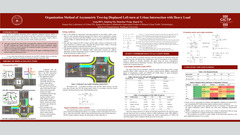
Organization Method of Asymmetric Two-leg Displaced Left-turn at Urban Intersection with Heavy Load
ID:1
View Protection:ATTENDEE
Updated Time:2021-12-13 17:08:03
Hits:431
Poster Presentation
Start Time:Pending(Asia/Shanghai)
Duration:Pending
Session:No Session »
Presentation File
Attachment File
Tips: Only the registered participant can access the file. Please sign in first.
Abstract
As the bottleneck of urban traffic, the intersection is the key to mitigating traffic congestion. Displaced left-turn (DLT) is a novel countermeasure that can effectively relieve the conflicts of the heavy traffic flows in different directions at the urban intersection by transferring them to the adjacent road sections, which is efficaciously able to improve traffic capacity, reduce delay and lower traffic conflict point density. This paper takes the urban intersection with heavy traffic load as the research object, systematically expounds the characteristics and applicable conditions of DLT, and then builds the DLT dedicated lane length calculation model and the signal coordination control method, on which it’s based to propose the organization design of asymmetric two-leg DLT which is more flexible and adaptable than ordinary DLT. Then, the fuzzy comprehensive evaluation model based on the degree of Hamming closeness is used to evaluate its optimization effect. Finally, a case study using simulated data showed that the asymmetric two-leg DLT evidently effects on relieving the serious traffic congestion, benefiting environment and improving traffic safety.
Keywords
Asymmetric Two-leg Displaced Left-turn;Signal Coordination Control;Fuzzy Comprehensive Evaluation
Speaker

Jingfeng Ma
Southeast UniversityAll Comments
Important Date
-
Conference Date
Dec 17
2021
toDec 20
2021
-
Dec 16 2021
Contribution Submission Deadline
-
Dec 24 2021
Registration deadline
Sponsored By
Chinese Overseas Transportation Association
Chang'an University
Chang'an University
Contact Information
- CICTP2020-21 Conference Organizing Committee
- ci******@gmail.com
Previous Conferences
-
2025-07-22 China 广州市(Guangzhou)
第25届COTA国际交通科技年会 -
2024-07-23 China Shenzhen
第24届海外华人交通协会国际交通科技年会(CICTP 2024) -
2023-07-15 China 北京(Beijing)
海外华人交通协会国际交通科技年会 -
2022-07-08 China Changsha
The 22nd COTA International Conference of Transportation Professionals -
2019-07-06 China 南京
The 19th COTA International Conference of Transportation Professionals -
2018-07-05 China Haidian District
18th COTA International Conference of Transportation Professionals -
2016-07-06 China Shanghai, China
The 16th COTA conference International Conference of Transportation Professionals -
2013-08-14 China 深圳市
International Conference of Transportation Professionals

Submit Comment