Presentation Details
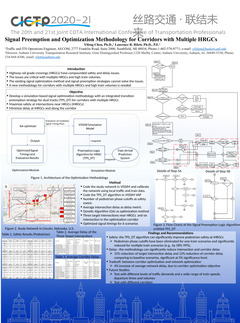
Signal Preemption and Optimization Methodology for Corridors with Multiple HRGCs
ID:1377
View Protection:ATTENDEE
Updated Time:2021-12-14 23:42:59
Hits:238
Poster Presentation
Start Time:2021-12-17 10:30(Asia/Shanghai)
Duration:1min
Session:P1 Poster2020 »
Abstract
Safety and efficiency are two critical issues at highway-rail grade crossings (HRGCs) and their nearby intersections. The standard preemption, which is the current preemption method for traffic signals located near highway-rail grade crossings, is designed to clear vehicles off tracks as soon as possible. However, the underlying logic of current practice provides little or no consideration to 1) pedestrian safety, and 2) traffic signal efficiency of signalized intersections near highway-rail grade crossings (IHRGCs). As a result, the state-of-the-practice traffic signal preemption strategies may cause safety and efficiency problems at these intersections. On the other hand, standard traffic signal optimization programs are not designed to work on roadway networks that contain multiple HRGCs, because their underlying assumption is that the roadway traffic is in a steady state. However, for corridors that experience high train traffic (e.g. over 2 trains per hour) non-steady state conditions predominate. To solve these issues, this paper developed a simulation-based optimization methodology for estimating traffic signal timing plans on arterial corridors with multiple IHRGCs, and a case study was conducted to evaluate the methodology. A Genetic Algorithm (GA) was used as the optimization approach in the proposed methodology. A new transition preemption strategy for dual tracks (TPS_DT) and a train arrival prediction model were integrated in the proposed methodology. A study corridor with multiple HRGCs in Lincoln, NE was used in the case study, and a sensitivity analysis with different train traffic scenarios was conducted. Measurements of Effectiveness (MOEs) used for evaluation include rate of pedestrian cutoffs, intersection vehicle delay and corridor vehicle delay. It was concluded that the methodology can significantly improve both the safety and efficiency of traffic corridors with multiple IHRGCs.
Keywords
CICTP
Speaker

Yifeng Chen
AECOMSubmission Author
All Comments
Important Date
-
Conference Date
Dec 17
2021
toDec 20
2021
-
Dec 16 2021
Contribution Submission Deadline
-
Dec 24 2021
Registration deadline
Sponsored By
Chinese Overseas Transportation Association
Chang'an University
Chang'an University
Contact Information
- CICTP2020-21 Conference Organizing Committee
- ci******@gmail.com
Previous Conferences
-
2025-07-22 China 广州市(Guangzhou)
第25届COTA国际交通科技年会 -
2024-07-23 China Shenzhen
第24届海外华人交通协会国际交通科技年会(CICTP 2024) -
2023-07-15 China 北京(Beijing)
海外华人交通协会国际交通科技年会 -
2022-07-08 China Changsha
The 22nd COTA International Conference of Transportation Professionals -
2019-07-06 China 南京
The 19th COTA International Conference of Transportation Professionals -
2018-07-05 China Haidian District
18th COTA International Conference of Transportation Professionals -
2016-07-06 China Shanghai, China
The 16th COTA conference International Conference of Transportation Professionals -
2013-08-14 China 深圳市
International Conference of Transportation Professionals

Submit Comment