Presentation Details
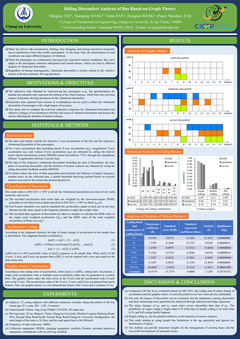
Riding discomfort analysis of bus based on graph theory
ID:1914
View Protection:ATTENDEE
Updated Time:2021-12-16 17:46:57
Hits:293
Poster Presentation
Start Time:2021-12-17 08:45(Asia/Shanghai)
Duration:1min
Session:P2 Poster2021 »
Abstract
In order to reduce the discomfort of passengers and improve the service quality of buses, firstly, 18 real riding experiments were conducted to collect acceleration data of the bus and passengers' riding experience by using micro-electro-mechanical systems sensor (MEMS) and riding discomfort feedback module (RDFM). Then the data is preprocessed and the discomfort of passengers is divided into three levels: mild, moderate and severe. The coding rule of acceleration mutation and the graphic matrix of each discomfort level are established and drawn. Finally, statistical and ridge regression methods were used to quantitatively analyze the relationship between the coding and the discomfort and the duration of motion sickness. The results show that acceleration mutation in different axial directions will cause different degrees of riding discomfort. The sudden acceleration / deceleration and bumps of vehicles can significantly affect the duration of motion sickness.
Keywords
CICTP
Speaker

Minghui Xie
Chang’an UniversitySubmission Author
All Comments
Important Date
-
Conference Date
Dec 17
2021
toDec 20
2021
-
Dec 16 2021
Contribution Submission Deadline
-
Dec 24 2021
Registration deadline
Sponsored By
Chinese Overseas Transportation Association
Chang'an University
Chang'an University
Contact Information
- CICTP2020-21 Conference Organizing Committee
- ci******@gmail.com
Previous Conferences
-
2025-07-22 China 广州市(Guangzhou)
第25届COTA国际交通科技年会 -
2024-07-23 China Shenzhen
第24届海外华人交通协会国际交通科技年会(CICTP 2024) -
2023-07-15 China 北京(Beijing)
海外华人交通协会国际交通科技年会 -
2022-07-08 China Changsha
The 22nd COTA International Conference of Transportation Professionals -
2019-07-06 China 南京
The 19th COTA International Conference of Transportation Professionals -
2018-07-05 China Haidian District
18th COTA International Conference of Transportation Professionals -
2016-07-06 China Shanghai, China
The 16th COTA conference International Conference of Transportation Professionals -
2013-08-14 China 深圳市
International Conference of Transportation Professionals

Submit Comment