Presentation Details
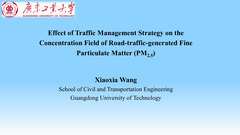
Effect of Traffic Management Strategy on the Concentration Field of Road-traffic-generated Fine Particulate Matter (PM2.5)
ID:2196
View Protection:ATTENDEE
Updated Time:2021-12-16 20:57:33
Hits:496
Oral Presentation
Start Time:2021-12-17 15:20(Asia/Shanghai)
Duration:15min
Session:T6 Track VI Future Transportation and Modern Logistics »
Abstract
Fine particulate matter (PM2.5) poses a potential threat to human health. The effects on PM2.5 before and after implementing a reversible lane were analysed based on a road segment. A simulation experiment was conducted, and the results were verified with normalized and measured concentration data. The PM2.5 concentration fields were studied in a series of cases with three different aspect ratios and two wind speeds. The average PM2.5 concentrations at y=0.5, y=1.5, and y=2.0 m after the implementation of the reversible lane decreased by 2.35%, 2.45%, and 2.70%, respectively. The effect of implementing a reversible lane on reducing PM2.5 concentration was outstanding when the aspect ratio H/W was 2:1, followed by H/W=1:1 and H/W=1:2. These findings will assist in designing streets with appropriate aspect ratios, developing an orderly strategy to implement variable lanes throughout an entire road network, and controlling road traffic flows to reduce the potential public harm of PM2.5.
Keywords
Speaker

Xiaoxia Wang
Guangdong University of TechnologyAll Comments
Important Date
-
Conference Date
Dec 17
2021
toDec 20
2021
-
Dec 16 2021
Contribution Submission Deadline
-
Dec 24 2021
Registration deadline
Sponsored By
Chinese Overseas Transportation Association
Chang'an University
Chang'an University
Contact Information
- CICTP2020-21 Conference Organizing Committee
- ci******@gmail.com
Previous Conferences
-
2025-07-22 China 广州市(Guangzhou)
第25届COTA国际交通科技年会 -
2024-07-23 China Shenzhen
第24届海外华人交通协会国际交通科技年会(CICTP 2024) -
2023-07-15 China 北京(Beijing)
海外华人交通协会国际交通科技年会 -
2022-07-08 China Changsha
The 22nd COTA International Conference of Transportation Professionals -
2019-07-06 China 南京
The 19th COTA International Conference of Transportation Professionals -
2018-07-05 China Haidian District
18th COTA International Conference of Transportation Professionals -
2016-07-06 China Shanghai, China
The 16th COTA conference International Conference of Transportation Professionals -
2013-08-14 China 深圳市
International Conference of Transportation Professionals

Submit Comment