Presentation Details
Influence of stabilization time and post processing methods on the accuracy of DC conductivity measurements
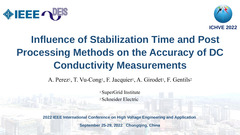
Start Time:Pending(Asia/Shanghai)
Duration:Pending
Session:No Session »
Tips: Only the registered participant can access the file. Please sign in first.
Abstract
With the development of DC networks, the study of conduction behaviors is fundamental for the development of equipment. In particular, the measurement method to determine the materials’ volume and surface conductivity must be reliable enough to give a consistent value under a reasonable measurement time. One method to determine these conductivities is to measure the polarization and depolarization currents of a material submitted to direct voltage. The related physical mechanisms being relatively slow, each measurement of these currents can spread over several hours or days. Thus, the aim of this work is to study the influence of the measurement duration and method on the final DC conductivity estimations, as well as to determine more optimal duration for most frequently used materials.
In order to observe the influence of measurement duration on several materials, four samples are tested, each made of a different material. Surface and bulk conductivity are measured on metallized disc samples at different DC voltages and temperatures, according to the IEC 62631 standard. The measurements were made simultaneously on all samples in a controlled environment with temperature regulation. For each experimental condition, the polarization and depolarization currents are measured for durations of 72 hours for bulk conductivity and 24 hours for surface conductivity.
After the measurements, the conduction currents are estimated to determine the materials’ conductivities. Three different methods are used to determine these conduction currents: the first one uses the polarization and the depolarization steps when the currents are stabilized, the second one is based on extrapolation from all the data of each step, and the third uses only the long polarization current. As the results vary depending on the range of data used (i.e., the measurement time considered) in each step, the influence of the measurement time on the DC volume and surface conductivity estimation can be evaluated. Because of the long-time measurements, the polarization and space charges injections phenomenon involved in some of the tested material can be observed.
Volume and surface DC conductivity measurements and the different analysis methods are presented in this paper in order to define the most adapted measurement protocol for different insulating materials. From the presented results, an optimal measurement time can be chosen by having an adapted compromise between accuracy of the results and measurement time.
Keywords
Speaker

Antoine Perez
Research engineer SuperGrid InstituteSubmission Author
All Comments
Important Date
-
Conference Date
Sep 25
2022
toSep 29
2022
-
Aug 15 2022
Early Bird Registration
-
Sep 10 2022
Contribution Submission Deadline
-
Nov 10 2022
Registration deadline
-
Nov 30 2022
Draft paper submission deadline
-
Nov 30 2022
Final Paper Deadline
Sponsored By
Organized By
Contact Information
- Zhengyong Huang
- 61******@qq.com
Previous Conferences
-
2020-09-06 China Beijing
2020 IEEE International Conference on High Voltage Engineering and Application -
2018-09-10 Greece
2018 IEEE International Conference on High Voltage Engineering and Application -
2016-09-19 China Chengdu, China
2016 IEEE International Conference on High Voltage Engineering and Application

Submit Comment