Presentation Details
Corona Discharge Degradation and Dynamic Drop Tests for Hydrophobicity Evaluation of High-Temperature Vulcanizing Silicone Rubber Samples
ID:433
View Protection:ATTENDEE
Updated Time:2022-08-29 16:06:48 Hits:301
Poster Presentation
Start Time:Pending(Asia/Shanghai)
Duration:Pending
Session:No Session »
Video
No Permission
Presentation File
Tips: Only the registered participant can access the file. Please sign in first.
Abstract
Silicone rubber (SiR) insulators have started to replace traditional porcelain/glass insulators due to several advantageous and have been increasingly used in power transmission and distribution networks. One of the outstanding features of SiR insulators is surface hydrophobicity. Resistance to the formation of conducting water paths, that suppress leakage current, the risk of flashover, and other degradation consequences, are due to the hydrophobicity feature. However, loss of hydrophobicity is a main problem for the SiR insulators. One reason for the hydrophobicity loss is corona discharges developing along the insulator as a result of imperfections in the metal sections of the power system and water droplets on the silicone surface. In this study, the loss of hydrophobicity of high-temperature vulcanizing (HTV) silicone rubber samples was evaluated. Commercially available HTV silicone rubber samples were used for this evaluation.
Experimental/Modeling methods
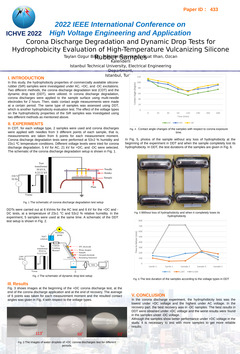
The hydrophobic properties of commercially available HTV silicone rubber samples are evaluated using two different test methods, namely corona discharge degradation test (CDT) and dynamic drop test (DDT) under AC, + DC, and -DC. Firstly, the loss and recovery of the hydrophobicity are investigated by applying corona discharges utilizing a CDT setup. Two samples were exposed to the corona discharges simultaneously for two hours for each voltage type. The static contact angle measurement method was used to assess the hydrophobicity feature according to the IEC 62073 standard. Contact angles were measured for the samples at 10, 20, 30, 60, and 120-minute steps after the corona discharge started. Contact angles are also measured during the recovery period. For recovery of the hydrophobicity, the contact angles were measured 2, 4, 8 hours periods after the end of the corona discharge test. Corona discharge degradation tests were performed at 52 ± 1 % humidity and 23±1 ⁰C temperature conditions. Secondly, the hydrophobicity performance of the samples was investigated by performing (DDT), considering CIGRE TB 442 documentation. DDTs were carried out at 50 Hz AC, +DC, and -DC voltages, at the mentioned ambient conditions, and 1 ml/min contamination flow rate. For each test voltage, five identical samples were used.
Results/discussion
In the corona discharge degradation test, the loss and recovery of hydrophobicity were observed by the contact angle measurements. With the dynamic drop test, it was observed that the hydrophobicity decreased as time passed, then it was completely lost and a water path was formed, and time-to-hydrophobicity losses were recorded. In corona discharge tests, there is a sharp decrease in the contact angles at the initial part of the tests.
Conclusions
In this study, the hydrophobicity of the HTV silicone rubber samples was evaluated under AC, +DC, and -DC high voltages. For this, 2 different test systems were used and the results from these test systems about the hydrophilicity loss were compared.
Experimental/Modeling methods
The hydrophobic properties of commercially available HTV silicone rubber samples are evaluated using two different test methods, namely corona discharge degradation test (CDT) and dynamic drop test (DDT) under AC, + DC, and -DC. Firstly, the loss and recovery of the hydrophobicity are investigated by applying corona discharges utilizing a CDT setup. Two samples were exposed to the corona discharges simultaneously for two hours for each voltage type. The static contact angle measurement method was used to assess the hydrophobicity feature according to the IEC 62073 standard. Contact angles were measured for the samples at 10, 20, 30, 60, and 120-minute steps after the corona discharge started. Contact angles are also measured during the recovery period. For recovery of the hydrophobicity, the contact angles were measured 2, 4, 8 hours periods after the end of the corona discharge test. Corona discharge degradation tests were performed at 52 ± 1 % humidity and 23±1 ⁰C temperature conditions. Secondly, the hydrophobicity performance of the samples was investigated by performing (DDT), considering CIGRE TB 442 documentation. DDTs were carried out at 50 Hz AC, +DC, and -DC voltages, at the mentioned ambient conditions, and 1 ml/min contamination flow rate. For each test voltage, five identical samples were used.
Results/discussion
In the corona discharge degradation test, the loss and recovery of hydrophobicity were observed by the contact angle measurements. With the dynamic drop test, it was observed that the hydrophobicity decreased as time passed, then it was completely lost and a water path was formed, and time-to-hydrophobicity losses were recorded. In corona discharge tests, there is a sharp decrease in the contact angles at the initial part of the tests.
Conclusions
In this study, the hydrophobicity of the HTV silicone rubber samples was evaluated under AC, +DC, and -DC high voltages. For this, 2 different test systems were used and the results from these test systems about the hydrophilicity loss were compared.
Keywords
Corona Discharge Degradation, Dynamic Drop Test, Hydrophobicity, Silicone Rubber
Speaker

Taylan Ozgur Bilgic
Istanbul Technical UniversitySubmission Author
All Comments
Important Date
-
Conference Date
Sep 25
2022
toSep 29
2022
-
Aug 15 2022
Early Bird Registration
-
Sep 10 2022
Contribution Submission Deadline
-
Nov 10 2022
Registration deadline
-
Nov 30 2022
Draft paper submission deadline
-
Nov 30 2022
Final Paper Deadline
Sponsored By
IEEE DEIS
Organized By
Chongqing University
Contact Information
- Zhengyong Huang
- 61******@qq.com
Previous Conferences
-
2020-09-06 China Beijing
2020 IEEE International Conference on High Voltage Engineering and Application -
2018-09-10 Greece
2018 IEEE International Conference on High Voltage Engineering and Application -
2016-09-19 China Chengdu, China
2016 IEEE International Conference on High Voltage Engineering and Application

Submit Comment