Presentation Details
Comparative Investigation of Corona Pulse Characteristics under DC and AC voltages
ID:434
View Protection:ATTENDEE
Updated Time:2022-08-29 16:06:52 Hits:269
Poster Presentation
Start Time:Pending(Asia/Shanghai)
Duration:Pending
Session:No Session »
Video
No Permission
Presentation File
Tips: Only the registered participant can access the file. Please sign in first.
Abstract
Purpose/Aim
Corona discharge, a widespread partial discharge type, is a benchmark of the existence of the insulation problem in high voltage systems. Its main detrimental effects can be listed as electrical power losses, degradation of insulation materials, electromagnetic interferences, etc. Sharp edges, points, small curvature under high electrical field stress (high potential gradient) are reasons for this type of discharge. This undesired phenomenon in HV assets should be detected and controlled (suppressed) before its unavoidable consequences.
HVDC systems are becoming widespread in both electrical transmission and distribution networks due to their several advantages such as easily interconnected different networks, absence of reactive components, etc. In contrast to HVAC systems, there is still a gap in the corona discharge research for HVDC systems despite increasing academic studies. HVDC corona discharge, its effect on the system, how it will create valuable fingerprints in asset management are among current research topics. Thus, the basic motivation of the study is to differentiate +DC, -DC, and AC corona discharges using the corona pulse feature via machine learning methods.
Experimental/Modeling methods
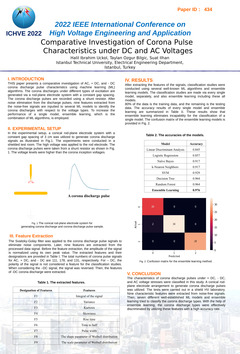
This study presents a comparative investigation of corona pulse characteristics under + DC, - DC, and AC voltage excitations. A conical plane electrode system was used for the study to generate corona discharge pulses. Electrode spacing was kept constant as 3 cm. The tests were conducted in a shielded test room at an ambient temperature of 20 ± 2 C⁰ and relative humidity of 50 ± 5 %. Current pulses were recorded through a shunt resistor with the help of a digital storage oscilloscope with a 200 MHz sampling frequency. Noises from corona signals were removed. Changes in current pulse features concerning the voltage types and levels were investigated, by considering several statistical features (pulse width, skewness, kurtosis, rise time, fall time, etc.) and Weibull distribution parameters.
Results/discussion
After the feature extraction part, the corona discharges were classified with respect to the voltage types using different machine learning algorithms, such as Support Vector Machine (SVM), K-Nearest Neighbors (KNN), and Decision Tree (DT) algorithms. It is shown that the features extracted are enough to classify these types of corona discharge.
Conclusions
This study gives a framework for classifying corona discharges according to voltage types. In hybrid systems (containing both AC and DC high voltages), it will be able to provide information about the system where the corona-induced deterioration is available.
Corona discharge, a widespread partial discharge type, is a benchmark of the existence of the insulation problem in high voltage systems. Its main detrimental effects can be listed as electrical power losses, degradation of insulation materials, electromagnetic interferences, etc. Sharp edges, points, small curvature under high electrical field stress (high potential gradient) are reasons for this type of discharge. This undesired phenomenon in HV assets should be detected and controlled (suppressed) before its unavoidable consequences.
HVDC systems are becoming widespread in both electrical transmission and distribution networks due to their several advantages such as easily interconnected different networks, absence of reactive components, etc. In contrast to HVAC systems, there is still a gap in the corona discharge research for HVDC systems despite increasing academic studies. HVDC corona discharge, its effect on the system, how it will create valuable fingerprints in asset management are among current research topics. Thus, the basic motivation of the study is to differentiate +DC, -DC, and AC corona discharges using the corona pulse feature via machine learning methods.
Experimental/Modeling methods
This study presents a comparative investigation of corona pulse characteristics under + DC, - DC, and AC voltage excitations. A conical plane electrode system was used for the study to generate corona discharge pulses. Electrode spacing was kept constant as 3 cm. The tests were conducted in a shielded test room at an ambient temperature of 20 ± 2 C⁰ and relative humidity of 50 ± 5 %. Current pulses were recorded through a shunt resistor with the help of a digital storage oscilloscope with a 200 MHz sampling frequency. Noises from corona signals were removed. Changes in current pulse features concerning the voltage types and levels were investigated, by considering several statistical features (pulse width, skewness, kurtosis, rise time, fall time, etc.) and Weibull distribution parameters.
Results/discussion
After the feature extraction part, the corona discharges were classified with respect to the voltage types using different machine learning algorithms, such as Support Vector Machine (SVM), K-Nearest Neighbors (KNN), and Decision Tree (DT) algorithms. It is shown that the features extracted are enough to classify these types of corona discharge.
Conclusions
This study gives a framework for classifying corona discharges according to voltage types. In hybrid systems (containing both AC and DC high voltages), it will be able to provide information about the system where the corona-induced deterioration is available.
Keywords
HVDC, HVDC, CORONA DISCHARGE, MACHINE LEARNING
Speaker

Halil Ibrahim Uckol
Student Istanbul Technical UniversitySubmission Author
All Comments
Important Date
-
Conference Date
Sep 25
2022
toSep 29
2022
-
Aug 15 2022
Early Bird Registration
-
Sep 10 2022
Contribution Submission Deadline
-
Nov 10 2022
Registration deadline
-
Nov 30 2022
Draft paper submission deadline
-
Nov 30 2022
Final Paper Deadline
Sponsored By
IEEE DEIS
Organized By
Chongqing University
Contact Information
- Zhengyong Huang
- 61******@qq.com
Previous Conferences
-
2020-09-06 China Beijing
2020 IEEE International Conference on High Voltage Engineering and Application -
2018-09-10 Greece
2018 IEEE International Conference on High Voltage Engineering and Application -
2016-09-19 China Chengdu, China
2016 IEEE International Conference on High Voltage Engineering and Application

Submit Comment