Presentation Details
Vibration Measurement and Data Analysis on Transformer Site
ID:511
View Protection:ATTENDEE
Updated Time:2022-08-29 16:13:49 Hits:302
Poster Presentation
Start Time:Pending(Asia/Shanghai)
Duration:Pending
Session:No Session »
Video
No Permission
Presentation File
Tips: Only the registered participant can access the file. Please sign in first.
Abstract
Purpose/Aim
The stray current of rail transit will invade the urban power grid and cause the DC bias of the transformer. When the transformer is biased, abnormal excitation current harmonics, vibration, noise and abnormal temperature rise will occur, which seriously endangers the safety of the transformer itself and the power supply reliability of the power grid. There is no centralized monitoring of the transformer vibration component in the power system, so it is necessary to obtain the measured data of vibration acceleration to further analyze the vibration mode of the transformer's DC bias and provide a reference for the safe operation of the transformer.
Experimental/Modeling methods
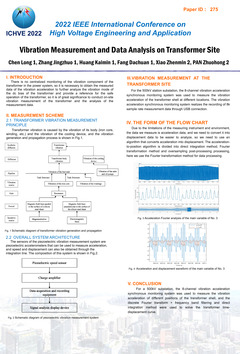
For a 500kV substation, an 8-channel vibration acceleration synchronous monitoring system is used to measure the vibration acceleration at different positions of the transformer shell. The 8-channel vibration acceleration synchronous monitoring system consists of two single-axis acceleration sensors, two three-axis acceleration sensors, and an 8-channel synchronous adjustment data acquisition system. The vibration and acceleration synchronous monitoring system realizes the recording of measurement data with 8k sampling rate through USB connection. According to the measurement results, the paper adopts discrete Fourier transform + frequency band filtering and direct integration method to solve the transformer time-displacement curve.
Results/discussion
Spectral analysis of the acceleration signal shows that the 50 Hz octave has a higher amplitude. Spectral points with larger amplitudes include 200 Hz, 400 Hz, and 450 Hz. 200 Hz corresponds to the harmonic current component of 100 Hz, and 400 Hz corresponds to the harmonic current component of 200 Hz. 450Hz is due to the change of vibration frequency caused by the internal structure of the transformer, and it is inferred that it is caused by the current of 200Hz. The analysis results of the time-displacement curve of the transformer show that the maximum displacement of the 500kV transformer can reach 11 microns under the condition of stray current intrusion.
Conclusions
For a 500kV substation, the 8-channel vibration acceleration synchronous monitoring system was used to measure the vibration acceleration at different positions of the transformer shell, and the discrete Fourier transform + frequency band filtering and direct integration method were used to solve the transformer time-displacement curve. The spectrum analysis results of the acceleration signal show that the maximum acceleration can reach 16m/s2, and the maximum displacement can reach 11 microns. The vibration modes of the three 500kV transformers are different; the larger transformer has fewer vibration frequencies and is relatively concentrated; the smaller transformer has more vibration frequencies and is scattered.
The stray current of rail transit will invade the urban power grid and cause the DC bias of the transformer. When the transformer is biased, abnormal excitation current harmonics, vibration, noise and abnormal temperature rise will occur, which seriously endangers the safety of the transformer itself and the power supply reliability of the power grid. There is no centralized monitoring of the transformer vibration component in the power system, so it is necessary to obtain the measured data of vibration acceleration to further analyze the vibration mode of the transformer's DC bias and provide a reference for the safe operation of the transformer.
Experimental/Modeling methods
For a 500kV substation, an 8-channel vibration acceleration synchronous monitoring system is used to measure the vibration acceleration at different positions of the transformer shell. The 8-channel vibration acceleration synchronous monitoring system consists of two single-axis acceleration sensors, two three-axis acceleration sensors, and an 8-channel synchronous adjustment data acquisition system. The vibration and acceleration synchronous monitoring system realizes the recording of measurement data with 8k sampling rate through USB connection. According to the measurement results, the paper adopts discrete Fourier transform + frequency band filtering and direct integration method to solve the transformer time-displacement curve.
Results/discussion
Spectral analysis of the acceleration signal shows that the 50 Hz octave has a higher amplitude. Spectral points with larger amplitudes include 200 Hz, 400 Hz, and 450 Hz. 200 Hz corresponds to the harmonic current component of 100 Hz, and 400 Hz corresponds to the harmonic current component of 200 Hz. 450Hz is due to the change of vibration frequency caused by the internal structure of the transformer, and it is inferred that it is caused by the current of 200Hz. The analysis results of the time-displacement curve of the transformer show that the maximum displacement of the 500kV transformer can reach 11 microns under the condition of stray current intrusion.
Conclusions
For a 500kV substation, the 8-channel vibration acceleration synchronous monitoring system was used to measure the vibration acceleration at different positions of the transformer shell, and the discrete Fourier transform + frequency band filtering and direct integration method were used to solve the transformer time-displacement curve. The spectrum analysis results of the acceleration signal show that the maximum acceleration can reach 16m/s2, and the maximum displacement can reach 11 microns. The vibration modes of the three 500kV transformers are different; the larger transformer has fewer vibration frequencies and is relatively concentrated; the smaller transformer has more vibration frequencies and is scattered.
Keywords
Vibration acceleration,Field measurements,Fourier transform,Band filtering
Speaker

Zhuohong PAN
North China Electric Power UniversitySubmission Author
All Comments
Important Date
-
Conference Date
Sep 25
2022
toSep 29
2022
-
Aug 15 2022
Early Bird Registration
-
Sep 10 2022
Contribution Submission Deadline
-
Nov 10 2022
Registration deadline
-
Nov 30 2022
Draft paper submission deadline
-
Nov 30 2022
Final Paper Deadline
Sponsored By
IEEE DEIS
Organized By
Chongqing University
Contact Information
- Zhengyong Huang
- 61******@qq.com
Previous Conferences
-
2020-09-06 China Beijing
2020 IEEE International Conference on High Voltage Engineering and Application -
2018-09-10 Greece
2018 IEEE International Conference on High Voltage Engineering and Application -
2016-09-19 China Chengdu, China
2016 IEEE International Conference on High Voltage Engineering and Application

Submit Comment