Presentation Details
Power Transformer Defect Prediction Method Based on SMOTE and Random Forest Algorithm
ID:568
View Protection:ATTENDEE
Updated Time:2022-09-09 15:35:52
Hits:328
Poster Presentation
Start Time:Pending(Asia/Shanghai)
Duration:Pending
Session:No Session »
Abstract
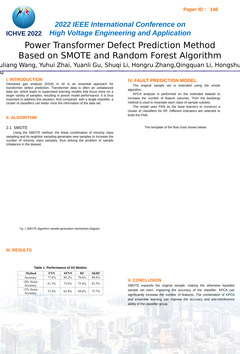
Dissolved gas analysis (DGA) in oil is an essential approach for transformer defect prediction. Most of the transformer defect prediction studies use artificial intelligence methods to build individual classifiers. Artificial intelligence techniques are highly sensitive to data. Transformer data is often an unbalanced data set, which leads to supervised learning models that focus more on a larger variety of samples, resulting in poorer model performance. To address this situation, this paper uses the synthetic minority oversampling technique (SMOTE) algorithm to oversample a few classes and mitigate the class imbalance problem of the sample set. Compared with a single classifier, a cluster of classifiers can better mine the information of the data set. In this paper, a feedforward neural network (FNN) is used as the base learner to construct a random forest (RF) model, and the variability among the base learners is increased by mapping the samples to a high-dimensional space through kernel principal component analysis (KPCA). Experimental results on faulty samples as well as noisy samples show that SMOTE can significantly enhance the precision of the classifier, but the problem of classification ambiguity occurs between some species. KPCA makes the characteristics of the dataset more obvious. The diagnostic effectiveness and interference resistance of the random forest model constructed in this paper are superior compared to other individual classifier algorithms mentioned in this paper.
Keywords
Transformer defect prediction;Dissolved gas analysis(DGA);Synthetic minority oversampling technique(SMOTE);Random Forest(RF)
Speaker

Xuliang Wang
School of Electrical Engineering;Shandong UniversitySubmission Author
All Comments
Important Date
-
Conference Date
Sep 25
2022
toSep 29
2022
-
Aug 15 2022
Early Bird Registration
-
Sep 10 2022
Contribution Submission Deadline
-
Nov 10 2022
Registration deadline
-
Nov 30 2022
Draft paper submission deadline
-
Nov 30 2022
Final Paper Deadline
Sponsored By
IEEE DEIS
Organized By
Chongqing University
Contact Information
- Zhengyong Huang
- 61******@qq.com
Previous Conferences
-
2020-09-06 China Beijing
2020 IEEE International Conference on High Voltage Engineering and Application -
2018-09-10 Greece
2018 IEEE International Conference on High Voltage Engineering and Application -
2016-09-19 China Chengdu, China
2016 IEEE International Conference on High Voltage Engineering and Application

Submit Comment