Presentation Details
Weakened relationship between ENSO and Antarctic sea ice in recent decades
ID:344
View Protection:ATTENDEE
Updated Time:2022-07-08 16:17:48
Hits:1141
Oral Presentation
Start Time:2022-07-27 16:55(Asia/Shanghai)
Duration:15min
Session:S4 热带与中高纬气候系统相互作用 »
No files
Abstract
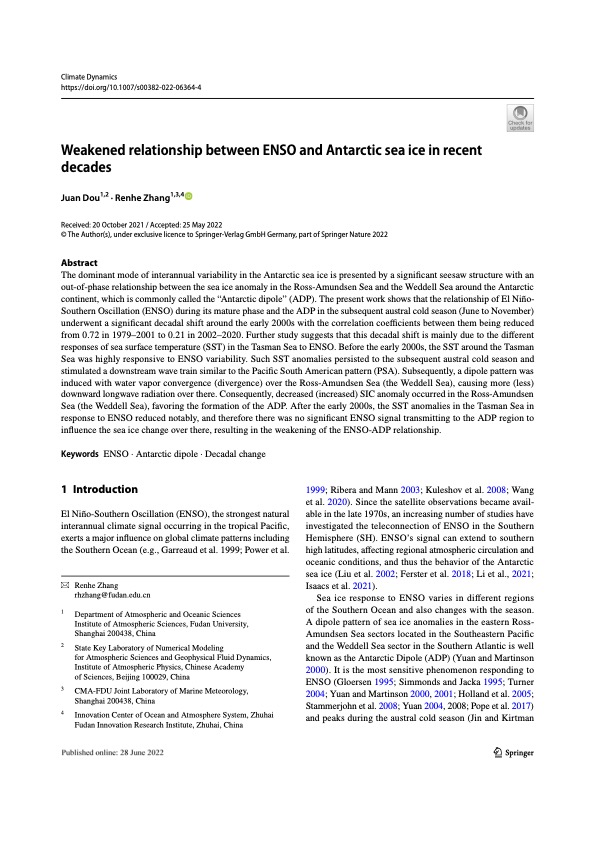
The dominant mode of interannual variability in the Antarctic sea ice is presented by a signifcant seesaw structure with an out-of-phase relationship between the sea ice anomaly in the Ross-Amundsen Sea and the Weddell Sea around the Antarctic continent, which is commonly called the “Antarctic dipole” (ADP). The present work shows that the relationship of El NiñoSouthern Oscillation (ENSO) during its mature phase and the ADP in the subsequent austral cold season (June to November) underwent a signifcant decadal shift around the early 2000s with the correlation coefcients between them being reduced from 0.72 in 1979–2001 to 0.21 in 2002–2020. Further study suggests that this decadal shift is mainly due to the diferent responses of sea surface temperature (SST) in the Tasman Sea to ENSO. Before the early 2000s, the SST around the Tasman Sea was highly responsive to ENSO variability. Such SST anomalies persisted to the subsequent austral cold season and stimulated a downstream wave train similar to the Pacifc South American pattern (PSA). Subsequently, a dipole pattern was induced with water vapor convergence (divergence) over the Ross-Amundsen Sea (the Weddell Sea), causing more (less) downward longwave radiation over there. Consequently, decreased (increased) SIC anomaly occurred in the Ross-Amundsen Sea (the Weddell Sea), favoring the formation of the ADP. After the early 2000s, the SST anomalies in the Tasman Sea in response to ENSO reduced notably, and therefore there was no signifcant ENSO signal transmitting to the ADP region to infuence the sea ice change over there, resulting in the weakening of the ENSO-ADP relationship.
Keywords
Speaker

豆娟
博士后 复旦大学All Comments
Important Date
-
Conference Date
Jul 27
2022
toJul 28
2022
-
Jun 30 2022
Draft paper submission deadline
-
Jul 19 2022
Registration deadline
Sponsored By
中国气象学会
Contact Information
Previous Conferences
-
2021-11-06 China 长沙市
中国气象学会气象青年科技交流会暨2021年青年科学家论坛 -
2017-11-01 China 东城区
中国气象学会2017年青年科学家论坛

Submit Comment