Presentation Details
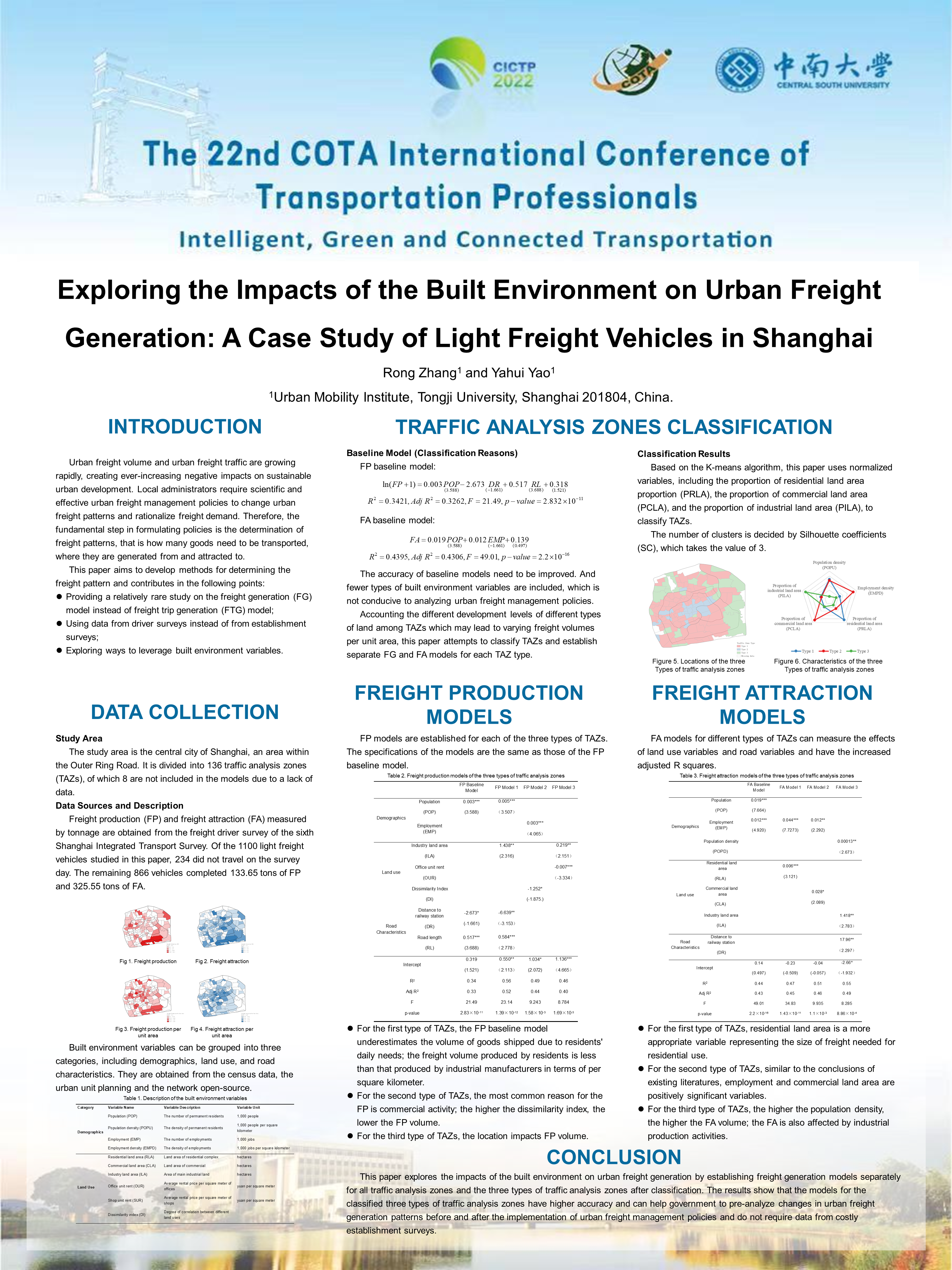
Exploring the Impacts of the Built Environment on Urban Freight Generation: A Case Study of Light Freight Vehicles in Shanghai
ID:64
View Protection:ATTENDEE
Updated Time:2022-07-10 10:03:45
Hits:320
Poster Presentation
Start Time:Pending(Asia/Shanghai)
Duration:Pending
Session:No Session »
Presentation File
Attachment File
Tips: Only the registered participant can access the file. Please sign in first.
Abstract
Urban freight transportation plays a vital role in meeting the cargo needs of citizens' lives and business operations. Using establishment factors to analyze urban freight generation does not effectively aid the government in developing urban freight management policies to guarantee economic growth and reduce negative externalities of urban freight. This paper explores the impact of the built environment factor on urban freight generation by creating regression models using goods transported by light freight vehicles in the central city of Shanghai. The models are constructed separately for all traffic analysis zones and the three types of traffic analysis zones after classification. The results show that the models for the classified three types of traffic analysis zones have higher accuracy and that land areas of different uses can be combined with population and employment to jointly predict the size of freight generation for residential life, commercial activities, and production activities.
Keywords
Speaker

Yahui Yao
PhD student Tongji UniversityAll Comments
Important Date
-
Conference Date
Jul 08
2022
toJul 11
2022
-
Jul 11 2022
Contribution Submission Deadline
-
Jul 11 2022
Registration deadline
Sponsored By
Chinese Overseas Transportation Association
Central South University (CSU)
Central South University (CSU)
Contact Information
- Conference Organizing Committee
- ci******@gmail.com
Previous Conferences
-
2025-07-22 China 广州市(Guangzhou)
第25届COTA国际交通科技年会 -
2024-07-23 China Shenzhen
第24届海外华人交通协会国际交通科技年会(CICTP 2024) -
2023-07-15 China 北京(Beijing)
海外华人交通协会国际交通科技年会 -
2021-12-17 China Xi'an
The 20th and 21st joint COTA International Conference of Transportation Professionals -
2019-07-06 China 南京
The 19th COTA International Conference of Transportation Professionals -
2018-07-05 China Haidian District
18th COTA International Conference of Transportation Professionals -
2016-07-06 China Shanghai, China
The 16th COTA conference International Conference of Transportation Professionals -
2013-08-14 China 深圳市
International Conference of Transportation Professionals

Submit Comment