Presentation Details
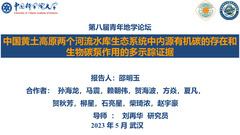
Multi-tracer evidence for the presence of autochthonous organic carbon and the role of biological carbon pump in two river–reservoir ecosystems on the Chinese Loess Plateau
ID:1484
View Protection:PRIVATE
Updated Time:2023-04-10 19:59:40
Hits:1981
Oral Presentation
Start Time:2023-05-08 09:08(Asia/Shanghai)
Duration:8min
Session:15C 15C、水文地球科学 »
Abstract
Dissolved inorganic carbon (DIC)-rich surface waters in the karst regions of southwest China (CKR) do not necessarily emit CO2 to the atmosphere during carbonate mineral precipitation, as DIC can be partially utilized during photosynthesis by aquatic plants under the biological carbon pump (BCP) effect, leading to autochthonous organic carbon (Auto-OC). However, the operation of BCP in surface waters of the Chinese Loess Plateau (CLP), which is also enriched in DIC, has not been well established, which limits our ability to accurately assess carbon sinks in inland surface waters. We combined stable isotope (δ2H, δ18O, and δ13C), C/N, ultraviolet absorption spectroscopy, and excitation-emission matrix fluorescence approaches to investigate the sources and compositions of particulate and dissolved OC in two river–reservoir ecosystems (Wulihe (WLH)-river to WLH-reservoir and Honghe (HH)-river to HH-reservoir) on the CLP. We found that from the inflow river to reservoir areas along the course of river flow, both DOC and POC signals from autochthonous production gradually increased, especially during the wet season (WS) with the same duration of rain and heat. Compared with the HH-reservoir, the WLH-reservoir had higher δ2H, δ18O, and δ13C values, protein-like fluorescence components, chlorophyll-a (Chl-a) and DOC concentrations, and lower CO2 efflux. Our results revealed that the BCP intensity of the WLH-reservoir was higher than that of the HH-reservoir, potentially due to the long water residence time of the WLH-reservoir. Additionally, although the amount of autochthonous dissolved organic matter (Auto-DOM) produced by BCP in the surface water on the CLP was lower than that in the CKR, the proportion of Auto-DOM in the former was close to that in the latter, indicating the significance of Auto-DOM in the surface water on the CLP. Furthermore, a significant negative correlation was found between the BCP-derived Auto-DOM and pCO2, while WLH-reservoir with stronger BCP effect exhibited CO2 influx in the WS (-1.47±0.02 g m-2 d-1), indicating that the enhanced BCP process contributed to the water–air interface C sink. Our research emphasizes the high BCP potential of surface water in the CLP, and provides a valuable elementary background to better understanding of the carbon cycle in the aquatic ecosystem of the CLP.
Keywords
Biological carbon pump; River–reservoir ecosystems; Autochthonous organic carbon; Chinese Loess Plateau; Stable isotope; EEM-PARAFRAC
Speaker

邵明玉
中国科学院地球化学研究所Submission Author
All Comments
Important Date
-
Conference Date
May 05
2023
toMay 08
2023
-
Mar 31 2023
Draft paper submission deadline
-
May 25 2023
Registration deadline
Sponsored By
青年地学论坛理事会
中国科学院青年创新促进会地学分会
中国科学院青年创新促进会地学分会
Organized By
武汉大学
中国科学院精密测量科学与技术创新研究院
中国地质大学(武汉)
中国科学院精密测量科学与技术创新研究院
中国地质大学(武汉)
Contact Information
- 管小彬
- gu******@whu.edu.cn
- +86********
- 孙佳妮
- sc******@aconf.org
- +86********

Submit Comment