Presentation Details
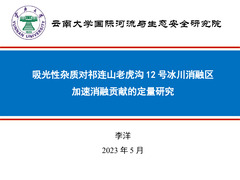
Dust dominates the summer melting of glacier ablation zones on the northeastern Tibetan Plateau
ID:2175
View Protection:PRIVATE
Updated Time:2023-04-25 17:21:12
Hits:2086
Oral Presentation
Start Time:2023-05-06 15:58(Asia/Shanghai)
Duration:12min
Session:18A 18A、冰冻圈科学 »
Abstract
Dust and black carbon (BC) can darken snow and ice surface and play pivotal roles in glacier mass loss. Thus, a quantitative assessment of their contributions to glacier summer melting is critical. During the summer of 2018, surface snow and ice were sampled, and the albedo and mass balance were continuously measured in the ablation zone of Laohugou Glacier No. 12 in the western Qilian Mountains. The physical properties of dust and BC were measured in the laboratory, and their impacts on glacier surface albedo reduction and melting were simulated. The results indicate that the ice surface in the ablation zone was enriched with substantial amounts of particles, and the average particle concentrations of these samples were hundreds of times higher than those of fresh snow. The BC mass absorption cross-sections (MACs) ranged from 3.1 m2 g−1 at 550 nm for dirty ice to 4.6 m2 g−1 for fresh snow, largely owing to meltwater percolation and particle collapse. The spectral variations in dust MACs were significantly different in the visible light bands and near-infrared bands from those in the other areas. Moreover, the two-layer surface energy and mass balance model with the new albedo parameterization formula was validated and agreed well with the experimental measurements of spectral albedo, broadband albedo, and mass balance. BC and dust combined resulted in 26.7% and 54.4% of the total mass loss on the cleaner and dirtier (particle enriched) surfaces in the ablation zone, respectively, compared to particle-free surfaces, and although both impurities played vital roles, dust was the more prominent factor in accelerating glacier melting on the northeastern Tibetan Plateau. This study emphasizes the importance of dust in cryosphere changes where Tibetan glaciers are strongly affected by Asian dust deposition.
Keywords
dust; black carbon; spectral albedo; enhanced melting; Tibetan Plateau
Speaker

李洋
云南大学Submission Author
All Comments
Important Date
-
Conference Date
May 05
2023
toMay 08
2023
-
Mar 31 2023
Draft paper submission deadline
-
May 25 2023
Registration deadline
Sponsored By
青年地学论坛理事会
中国科学院青年创新促进会地学分会
中国科学院青年创新促进会地学分会
Organized By
武汉大学
中国科学院精密测量科学与技术创新研究院
中国地质大学(武汉)
中国科学院精密测量科学与技术创新研究院
中国地质大学(武汉)
Contact Information
- 管小彬
- gu******@whu.edu.cn
- +86********
- 孙佳妮
- sc******@aconf.org
- +86********

Submit Comment