Presentation Details
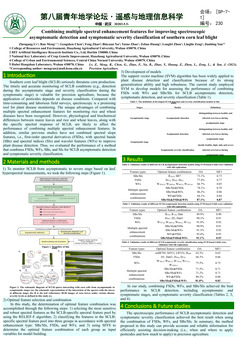
Combining multiple spectral enhancement features for improving spectroscopic asymptomatic detection and symptomatic severity classification of southern corn leaf blight
ID:230
View Protection:PRIVATE
Updated Time:2023-05-04 16:52:37
Hits:1486
Poster Presentation
Start Time:2023-05-06 08:15(Asia/Shanghai)
Duration:1min
Session:SP 张贴报告专场 »
Abstract
Southern corn leaf blight (SCLB) seriously threatens corn production. The timely and accurate monitoring of SCLB conditions (e.g., detection during the asymptomatic stage and severity classification during the symptomatic stage) is valuable for precision agriculture, because the application of pesticides depends on disease conditions. Compared with time-consuming and laborious field surveys, spectroscopy is a promising tool for plant disease monitoring. The unique advantages of combining multiple spectral enhancement features for monitoring rice and wheat diseases have been recognized. However, physiological and biochemical differences between maize leaves and rice and wheat leaves, along with the specific spectral response of SCLB, are likely to affect the performance of combining multiple spectral enhancement features. In addition, similar previous studies have not combined spectral slope features, i.e., first-order spectral derivatives (FSDs), with spectral bands (SBs) and spectral indices (SIs) and wavelet features (WFs) to improve plant disease detection. Thus, the performance of a method that combines FSDs, WFs, SBs, and SIs for SCLB asymptomatic detection, symptomatic detection, and symptomatic severity classification should be evaluated further. Here, the utility of combining SBs, SIs, WFs, and FSDs was quantified and evaluated in the asymptomatic detection, symptomatic detection, and symptomatic severity classification of SCLB. Various forms of spectral enhancement features that were sensitive to SCLB infection from the asymptomatic stage to the severe stage were first identified and combined using the RELIEF-F and sequential floating forward selection algorithms on the basis of two independent inoculation experiments. Finally, SCLB asymptomatic detection, symptomatic detection, and symptomatic severity classification models were developed and evaluated using the support vector machine algorithm. Results showed that combining FSDs with SBs, SIs, and WFs achieved the best performance in SCLB spectroscopic monitoring. (1) SCLB asymptomatic detection and symptomatic detection were moderately improved, i.e., overall accuracy (OA) and macro F1 (MF1) improved by ~ 1% to 2%. The OA of SCLB asymptomatic detection was 87.1% with an MF1 of 0.87, and that of symptomatic detection was 93.1% with an MF1 of 0.93. (2) SCLB symptomatic severity classification was significantly improved, i.e., OA and MF1 improved by ~ 7%. The OA of severity classification was 81.8% with am MF1 of 0.82.This study demonstrated that the complementary relationships among SBs, SIs, WFs, and FSDs could effectively improve SCLB spectroscopic monitoring. The proposed method provides a novel tool for large-scale SCLB spectroscopic monitoring. It has broad implications for assisting management decisions (i.e., when and where to apply pesticides and how much to apply) in precision agriculture.
Keywords
智慧农业;农业遥感;人工智能;植物病害
Speaker

孟冉
华中农业大学 赵平
博士生 华中农业大学Submission Author
All Comments
Important Date
-
Conference Date
May 05
2023
toMay 08
2023
-
Mar 31 2023
Draft paper submission deadline
-
May 25 2023
Registration deadline
Sponsored By
青年地学论坛理事会
中国科学院青年创新促进会地学分会
中国科学院青年创新促进会地学分会
Organized By
武汉大学
中国科学院精密测量科学与技术创新研究院
中国地质大学(武汉)
中国科学院精密测量科学与技术创新研究院
中国地质大学(武汉)
Contact Information
- 管小彬
- gu******@whu.edu.cn
- +86********
- 孙佳妮
- sc******@aconf.org
- +86********

Submit Comment