Presentation Details
Using Cd, Ba, and Ni isotope systematics as novel biomarkers to decipher Archean microbial metal cycling in the ~3.0 Ga Pongola Supergroup stromatolites
ID:2623
View Protection:PRIVATE
Updated Time:2023-04-11 22:33:51 Hits:1969
Invited speech
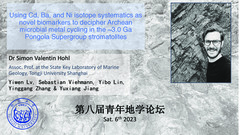
Start Time:2023-05-06 17:15(Asia/Shanghai)
Duration:15min
Session:17A 17A、古生物、古地理与古环境 »
Abstract
Stromatolitic carbonates are geochemical archives that allow studying the long-term interplay of the biosphere, atmosphere and hydrosphere through deep-time, with the unique potential to also investigate early life environments and the evolution of the metallome. Recently non-traditional stable isotopes of bioactive metals emerged as novel proxies to reconstruct the micronutrient cycling in stromatolitic microbial habitats.
In this study, we use stromatolites from the ~2.95 billion-year-old Pongola Supergroup (South Africa) as field laboratory for combined in-situ trace metal mapping and layer-specific novel stable metal isotope compositions to determine biogeochemical metal cycling in early Earth microbial habitats. LA ICP-MS maps reveal intrinsic bio-sedimentary enrichments of Ni and Cd in laminae; in contrast, Ba shows a more heterogeneous distribution throughout the stromatolite. Intra-laminae δ60Ni and δ112Cd follow typical kinetic isotopic fractionation, i.e., the isotopic composition of Cd and Ni evolves to heavier values with decreasing respective element concentrations arguing for carbonate precipitation from a fractionated Ni and Cd pool heavier than ambient silicate rocks. Further correlations with δ13C and macronutrient P argue for co-existing methanogenetic, and photogenetic metal uptake responsible for pronounced isotopic fractionation. In contrast, δ138Ba records isotope fractionation related to variable aragonite precipitation rates in the stromatolite, i.e., Ba evolves to isotopically heavier values with increasing concentrations under variable alkalinity in microbial habitats. We show that the combination of Cd and Ni isotopes has a unique potential as novel isotope biomarker for early Earths bio-chemical sediment record of where traditional biomarkers are not applicable due to fragmentary preservation of organic material.
In this study, we use stromatolites from the ~2.95 billion-year-old Pongola Supergroup (South Africa) as field laboratory for combined in-situ trace metal mapping and layer-specific novel stable metal isotope compositions to determine biogeochemical metal cycling in early Earth microbial habitats. LA ICP-MS maps reveal intrinsic bio-sedimentary enrichments of Ni and Cd in laminae; in contrast, Ba shows a more heterogeneous distribution throughout the stromatolite. Intra-laminae δ60Ni and δ112Cd follow typical kinetic isotopic fractionation, i.e., the isotopic composition of Cd and Ni evolves to heavier values with decreasing respective element concentrations arguing for carbonate precipitation from a fractionated Ni and Cd pool heavier than ambient silicate rocks. Further correlations with δ13C and macronutrient P argue for co-existing methanogenetic, and photogenetic metal uptake responsible for pronounced isotopic fractionation. In contrast, δ138Ba records isotope fractionation related to variable aragonite precipitation rates in the stromatolite, i.e., Ba evolves to isotopically heavier values with increasing concentrations under variable alkalinity in microbial habitats. We show that the combination of Cd and Ni isotopes has a unique potential as novel isotope biomarker for early Earths bio-chemical sediment record of where traditional biomarkers are not applicable due to fragmentary preservation of organic material.
Keywords
叠层石,镍同位素,钡同位素,镉同位,古代生活
Speaker

HohlSimon
Tongji UniversitySubmission Author
All Comments
Important Date
-
Conference Date
May 05
2023
toMay 08
2023
-
Mar 31 2023
Draft paper submission deadline
-
May 25 2023
Registration deadline
Sponsored By
青年地学论坛理事会
中国科学院青年创新促进会地学分会
中国科学院青年创新促进会地学分会
Organized By
武汉大学
中国科学院精密测量科学与技术创新研究院
中国地质大学(武汉)
中国科学院精密测量科学与技术创新研究院
中国地质大学(武汉)
Contact Information
- 管小彬
- gu******@whu.edu.cn
- +86********
- 孙佳妮
- sc******@aconf.org
- +86********

Submit Comment