Presentation Details
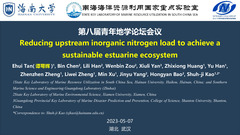
Reducing upstream inorganic nitrogen load to realize the self-purification of estuarine ecosystems
ID:2941
View Protection:PRIVATE
Updated Time:2023-04-12 19:07:31 Hits:1999
Oral Presentation
Start Time:2023-05-07 15:15(Asia/Shanghai)
Duration:15min
Session:6A 6A、海洋地球科学 »
Abstract
The excess reactive nitrogen (Nr) delivery driven by intensive anthropogenic activities has led to unprecedented pressures on estuaries and coastal oceans. How to maintain a healthy and sustainable ecosystem has become an ecological and socio-economic problem of global concern, which calls for a deeply understanding of Nr biogeochemical cycle, particularly, the fate of Nr in systems. Here, we quantitatively assess the two sedimentary Nr removal processes (denitrification and anammox) and associated nitrous oxide (N2O) production in the Pearl River Estuary (PRE). The coupling between the biogeochemical potentials and chlorophyll in spatial indicates that the quantity and quality of organic matter are important drivers for Nr loss and N2O production. Direct denitrification and coupled nitrification-denitrification are two main mechanisms of Nr removal in the PRE, which are largely depended on nitrate concentration and labile organic matter, respectively. The Nr self-purification capacity is 1.1×10⁷ mol N d-1, with 9.1×10⁶ mol N d-1 from denitrification and 2.2×10⁶ mol N d-1 from anammox, accounting for 25% of the total riverine Nr input. Such a result indicates that most of the Nr will be delivered to shelf seas under current high Nr input stress. In addition, sedimentary denitrification-induced N2O production (2.4×10⁵ mol N d-1) occupies 66 ± 27% of the daily sea-air N2O emission flux, playing a significant role in climatic feedback. We argue that riverine inorganic Nr controls the self-purification capacity of estuary via affecting the primary productivity and the subsequent labile organic matter sedimentation. Effective control measures in the future reduce the upstream Nr load maintaining the resilience of estuarine ecosystems and mitigating the climatic feedback. These findings contribute to policy makers to develop knowledge-based management actions for achieving a sustainable estuary.
Keywords
Nitrogen purification,Denitrification,Anammox,Climatic feedback,Knowledge-based management
Speaker

TanEhui
State Key Laboratory of Marine Resource Utilization in South China Sea, Hainan University, Haikou, Hainan, ChinaSubmission Author
All Comments
Important Date
-
Conference Date
May 05
2023
toMay 08
2023
-
Mar 31 2023
Draft paper submission deadline
-
May 25 2023
Registration deadline
Sponsored By
青年地学论坛理事会
中国科学院青年创新促进会地学分会
中国科学院青年创新促进会地学分会
Organized By
武汉大学
中国科学院精密测量科学与技术创新研究院
中国地质大学(武汉)
中国科学院精密测量科学与技术创新研究院
中国地质大学(武汉)
Contact Information
- 管小彬
- gu******@whu.edu.cn
- +86********
- 孙佳妮
- sc******@aconf.org
- +86********

Submit Comment