Presentation Details
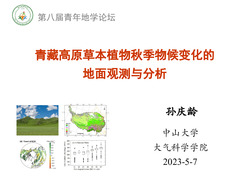
青藏高原草本植物秋季物候变化的地面观测与分析
ID:3379
View Protection:PRIVATE
Updated Time:2023-05-05 23:45:10
Hits:1654
Oral Presentation
Start Time:2023-05-07 14:05(Asia/Shanghai)
Duration:10min
Session:20 20、地球关键带与全球变化 »
Abstract
Plant autumn phenology affects ecosystem carbon and water cycles. However, autumn phenological shifts of herbaceous plants and their primary regulators on the Qinghai–Tibetan Plateau (QTP) remain uncertain because previous studies were mainly based on remote sensing data. Studies using ground autumn phenological data observed at many stations are very few. This study explored the primary drivers of temporal shifts in leaf senescence date (LSD) and assessed the relative importance of climatic factors and spring phenophases to LSD shifts using correlation analysis, general linear regression, and partial least squares regression based on 1685 phenological records at 27 stations on the QTP. Results showed that, preseason total precipitation (PRE) and minimum air temperature (Tmin) had higher correlation coefficients with LSD and displayed more extensive importance in predicting LSD than other factors. Despite larger influences, contributions of PRE and Tmin to LSD inter-annual variations were only 14.9% and 14.2%, respectively. In total, PRE and air temperatures (TEMs) just explained 38.0% of LSD temporal shifts. These results indicate that although PRE and TEMs are the major regulators of LSD, temporal shifts in LSD are controlled by multiple factors. Overall, climatic factors and spring phenology contributed 53.7% and 15.6% to LSD variations, respectively, which means that climate change obviously outweighed spring phenology in driving LSD shifts. Our study revealed a critical role of PRE in regulating LSD shifts directly or indirectly by enhancing the sensitivity of LSD to TEMs. Moreover, we found that the impacts of precipitation change were more prominent on LSD of sedges than those of grasses and forbs. Therefore, we suggest that accurate autumn phenological models for plants on the QTP should include multiple factors and incorporate the influences of precipitation. This study can also provide insight into QTP grassland management from the perspective of phenological responses to climate change.
Keywords
秋季物候,草本植物,地面观测,气候变化
Speaker

孙庆龄
中山大学Submission Author
All Comments
Important Date
-
Conference Date
May 05
2023
toMay 08
2023
-
Mar 31 2023
Draft paper submission deadline
-
May 25 2023
Registration deadline
Sponsored By
青年地学论坛理事会
中国科学院青年创新促进会地学分会
中国科学院青年创新促进会地学分会
Organized By
武汉大学
中国科学院精密测量科学与技术创新研究院
中国地质大学(武汉)
中国科学院精密测量科学与技术创新研究院
中国地质大学(武汉)
Contact Information
- 管小彬
- gu******@whu.edu.cn
- +86********
- 孙佳妮
- sc******@aconf.org
- +86********

Submit Comment