Presentation Details
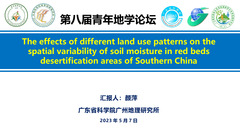
The effects of different land use patterns on the spatial variability of soil moisture in red beds desertification areas of Southern China
ID:3404
View Protection:PRIVATE
Updated Time:2023-04-15 15:06:22 Hits:2062
Oral Presentation
Start Time:2023-05-07 16:29(Asia/Shanghai)
Duration:8min
Session:20 20、地球关键带与全球变化 »
Abstract
Soil moisture is one of key factors that influences crop growth and the construction of ecological environments. Research regarding the spatial heterogeneity and driving factors of soil moisture is crucial for the efficient utilization of water resources and management of the ecological environment. To determine the causes of the spatial heterogeneity of soil moisture under four land-use patterns (cropland, forestland, grassland, and bare land) in the ecologically degraded red bed area of the Nanxiong basin under the humid conditions of South China, we used geostatistics and classic statistical methods to analyze the spatial variation of soil moisture, and then discuss the primary influencing factors. A good fit with high determination coefficients (0.876, 0.853) was obtained for cropland and forest when using a Gaussian model in the geostatistical analysis, while the soil moisture in bare land exhibited intermediate spatial autocorrelation which was affected by the structure and random factors. Through cross-validation, the results of inverse distance weighting were determined to be less than those of ordinary kriging, while ordinary kriging could more accurately reflect the spatial distribution of soil moisture in cropland, forestland, grassland, and bare land. Overall, the spatial heterogeneity of the soil moisture was primarily affected by natural and anthropogenic factors, including the structural characteristics of the soil, soil type, vegetation, climate, and changes in land-use patterns. Human intervention had the most prominent role in determining the spatial heterogeneity as well as the driving factors of soil moisture under the four land-use patterns in this typical red bed area.
Keywords
Red beds desertification,Land use patterns,Soil moisture,Spatial variation,Spatial distribution
Speaker

颜萍
助理研究员 广东省科学院广州地理研究所Submission Author
All Comments
Important Date
-
Conference Date
May 05
2023
toMay 08
2023
-
Mar 31 2023
Draft paper submission deadline
-
May 25 2023
Registration deadline
Sponsored By
青年地学论坛理事会
中国科学院青年创新促进会地学分会
中国科学院青年创新促进会地学分会
Organized By
武汉大学
中国科学院精密测量科学与技术创新研究院
中国地质大学(武汉)
中国科学院精密测量科学与技术创新研究院
中国地质大学(武汉)
Contact Information
- 管小彬
- gu******@whu.edu.cn
- +86********
- 孙佳妮
- sc******@aconf.org
- +86********

Submit Comment