Presentation Details
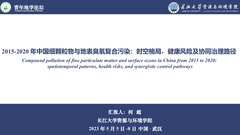
Compound pollution of fine particulate matter and surface ozone in China from 2015 to 2020: spatiotemporal patterns, health risks and synergistic control pathways
ID:3646
View Protection:PRIVATE
Updated Time:2023-04-16 17:49:43 Hits:1981
Oral Presentation
Start Time:2023-05-06 16:10(Asia/Shanghai)
Duration:15min
Session:14C 14C、气溶胶与大气环境 »
Abstract
The increasingly pronounced compound pollution issue of fine particulate matter (PM2.5) and surface ozone (O3) concentrations in China has exacerbated the risk of human morbidity and death. In this study, the spatial and temporal characteristics, health risks and synergistic control pathways of PM2.5–O3 compound pollution in 365 cities in China from 2015 to 2020 were investigated based on spatial statistical analysis, integrated risk index model and spatial correlation analysis. The results show that: The strict air pollution control measures lead to a sustained decrease in PM2.5 leading polluted cities and a sustained increase in clean cities during the study period. However, there is a trend of increasing (2015–2017) and then decreasing (2018–2020) in cities with compound PM2.5 and O3 pollution because of changes in volatile organic compounds (VOCs) and NOx caused by human activities. According to the exposure analysis method, the population exposed to PM2.5 dominated polluted cities declined by 471 million from 2015 to 2020; in contrast, the population living in clean cities increased by 460 million. With the intensification of PM2.5–O3 compound pollution in China, the exposure to PM2.5–O3 compound pollution urban population increases sharply from 349 million in 2015 to 622.5 million in 2018, an increase of more than 40%; as air quality improves after 2017, the population exposed to PM2.5–O3 compound pollution gradually decreases, falling to the equivalent level in 2015 by 2020. Meanwhile, the population health risks attributed to PM2.5 pollution were reduced, whereas the population health risks attributed to PM2.5–O3 compound pollution were aggravated. From a spatial perspective, PM2.5–O3 compound pollution and health risk exacerbation regions were concentrated in northern and eastern China. In addition, we found that PM2.5 and O3 concentrations have significant synergistic trends,which are consistent with VOC and NOx in spatial distribution, which is conducive to the synergistic management of PM2.5 and O3 in China.
Keywords
PM2.5¬–O3 compound pollution,Temporal spatial patterns,Integrated Health Risks,synergistic control pathways,China
Speaker

何超
长江大学Submission Author
All Comments
Important Date
-
Conference Date
May 05
2023
toMay 08
2023
-
Mar 31 2023
Draft paper submission deadline
-
May 25 2023
Registration deadline
Sponsored By
青年地学论坛理事会
中国科学院青年创新促进会地学分会
中国科学院青年创新促进会地学分会
Organized By
武汉大学
中国科学院精密测量科学与技术创新研究院
中国地质大学(武汉)
中国科学院精密测量科学与技术创新研究院
中国地质大学(武汉)
Contact Information
- 管小彬
- gu******@whu.edu.cn
- +86********
- 孙佳妮
- sc******@aconf.org
- +86********

Submit Comment