Presentation Details
Release, remobilization, and soil colloids-facilitated transport of heavy metals in contaminated soils from mining areas
ID:678
View Protection:PRIVATE
Updated Time:2023-04-10 20:38:25
Hits:1944
Oral Presentation
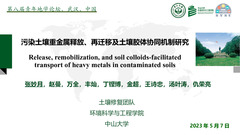
Start Time:2023-05-07 14:20(Asia/Shanghai)
Duration:10min
Session:19C 19C、土壤科学与环境健康 »
Abstract
Saturated soil column experiments were conducted to investigate the release and remobilization behaviors of heavy metals (Pb, Zn, Cu, and Cd) in the three contaminated soils from mine tailing (MT), wasteland (MW), and contaminated agricultural soil (CA) of Damai mountain mining area (Guangdong, China). Soil fractionation indicated that all the heavy metals exhibited the highest concentration in the water-dispersible colloids compared to clay, silt, and sand fractions. Significant amounts of heavy metals and soil colloids release especially in CA were observed with a reduction of ionic strength due to the expansion of the electrical double layer, especially following cation exchange (when K+ displaced Ca2+). The breakthrough curves of Fe, Al, and total organic matter in the effluent were consistent with that of heavy metals, suggesting that soil colloids are carriers to facilitate the transport of heavy metals. The asymmetric flow field flow fractionation (AF4) coupled to UV and inductively coupled plasma mass spectrometry (AF4-UV-ICP-MS) was further conducted to determine the association between heavy metals and soil colloids in the effluent. Results indicated that two size fractions of soil colloids were observed in the effluent. A finer fraction between 1 and 20 nm was mainly associated with organic colloids and a larger fraction in the range of 50 to 150 nm was mainly composed of Fe, Al, and Mn. Cu, Zn, and Cd exhibited higher affinity with the organic colloids in the finer fraction of soil colloids, while most of Pb were distributed on the larger fraction. The results of this study suggested that environmental effects like rainfalls, which will result in perturbation of soil solution, including ionic strength reduction and cation exchange, would induce heavy metals release into the groundwater and surrounding areas, which provided effective theoretical support for the prevention, control, and remediation of soil contamination by heavy metals.
Keywords
colloids-facilitated transport,heavy metals,mining areas
Speaker

张妙月
副教授 中山大学Submission Author
All Comments
Important Date
-
Conference Date
May 05
2023
toMay 08
2023
-
Mar 31 2023
Draft paper submission deadline
-
May 25 2023
Registration deadline
Sponsored By
青年地学论坛理事会
中国科学院青年创新促进会地学分会
中国科学院青年创新促进会地学分会
Organized By
武汉大学
中国科学院精密测量科学与技术创新研究院
中国地质大学(武汉)
中国科学院精密测量科学与技术创新研究院
中国地质大学(武汉)
Contact Information
- 管小彬
- gu******@whu.edu.cn
- +86********
- 孙佳妮
- sc******@aconf.org
- +86********

Submit Comment