Presentation Details
Integrating protective and risk factors to understand the transition from suicidal ideation to suicide attempts: A latent profile analysis
ID:19
View Protection:ATTENDEE
Updated Time:2025-01-08 16:35:40
Hits:817
Extended type 1
Start Time:2025-01-10 20:00(Asia/Shanghai)
Duration:10min
Session:O 2025年中国国际心理危机学术研讨会 Day One »
Video
No Permission
Tips: Only the registered participant can access the file. Please sign in first.
Abstract
Objective
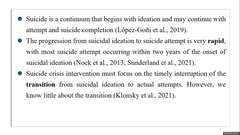
Improving suicide prediction and intervention requires a strengths-based perspective to understand the transition from suicidal ideation to suicide attempt. To achieve a more comprehensive understanding of the transition from suicidal ideation to attempt within the Chinese cultural context, the current study aims to further integrate protective factors that prevent the transition with risk factors that escalate it, thereby enhancing the precision of suicide prevention and intervention efforts. The first aim of this study is to develop effective questionnaires based on the three protective factors identified in prior research, in order to assess these factors comprehensively from the perspective of interrupting the transition. The second aim of the study is to employ both the developed protective-factor questionnaires and existing risk-factor questionnaires to evaluate and classify individuals into subgroups, thereby facilitating tailored interventions and enhancing suicide risk management.
Methods
Three rounds of data collection were conducted in Chinese colleges using self-reported online surveys. In the first round, three subsamples, consisting of 459, 410, and 318 participants respectively, were recruited. The data from these subsamples were utilized for exploratory factor analysis to develop questionnaires assessing protective factors. In the second round, 1,057 participants were recruited, and the data collected were used for confirmatory factor analysis to verify the developed protective-factor questionnaires. During the third round, 1,060 participants were recruited. Individuals were categorized into latent classes based on protective and risk factors using latent profile analysis. The suicide risk among the identified classes was compared using an ANOVA test.
Results & Discussion
The developed protective-factor questionnaires possessed a good fit and robust reliability and validity. Based on the developed effective protective-factor questionnaires, in combination with risk-factor questionnaires, 3 latent classes were identified: High Protection-Low Risk(n = 410, 40.5%), Balanced(n = 429, 42.4%),and Low Protection-High Risk(n = 173, 17.1%). We propose that the relationship between protective and risk factors is akin to a seesaw mechanism, where high protection corresponds to low risk, low protection to high risk. Protective factors (all η_p^2 > 0.14) were more effective than risk factors (all η_p^2 < 0.14) in distinguishing individuals. This finding underscores the importance of focusing more on protective factors than on risk factors, aligning with the cultural values of China. Incorporating the seesaw mechanism between protective and risk factors, future assessments might predict risk factors by evaluating protective factors, and interventions could reduce risk factors by bolstering protective factor.The "Low Protection-High Risk" was of particular concern among the 3 latent classes. Suicidal ideation in individuals of this subgroup was most likely to escalate to suicide attempts, given that the "Low Protection-High Risk" exhibited the highest levels of suicidal ideation intensity, suicidal urge intensity, and likelihood of future suicide attempts.
Conclusions
The developed protective-factor questionnaires can be utilized for psychological evaluation. Individuals can be classified into 3 latent classes: High Protection-Low Risk, Balanced, and Low Protection-High Risk. A seesaw mechanism existed between protective and risk factors. Protective factors were more effective than risk factors in distinguishing individuals. The "Low Protection-High Risk" subgroup was of utmost concern, as suicidal ideation in individuals of this subgroup is most likely to escalate to suicide attempts. Our findings contribute to the development of tailored suicide interventions, thereby potentially reducing suicide risk.
Acknowledgement: This work was supported by the National Social Science Fund of China (23BSH164).
Improving suicide prediction and intervention requires a strengths-based perspective to understand the transition from suicidal ideation to suicide attempt. To achieve a more comprehensive understanding of the transition from suicidal ideation to attempt within the Chinese cultural context, the current study aims to further integrate protective factors that prevent the transition with risk factors that escalate it, thereby enhancing the precision of suicide prevention and intervention efforts. The first aim of this study is to develop effective questionnaires based on the three protective factors identified in prior research, in order to assess these factors comprehensively from the perspective of interrupting the transition. The second aim of the study is to employ both the developed protective-factor questionnaires and existing risk-factor questionnaires to evaluate and classify individuals into subgroups, thereby facilitating tailored interventions and enhancing suicide risk management.
Methods
Three rounds of data collection were conducted in Chinese colleges using self-reported online surveys. In the first round, three subsamples, consisting of 459, 410, and 318 participants respectively, were recruited. The data from these subsamples were utilized for exploratory factor analysis to develop questionnaires assessing protective factors. In the second round, 1,057 participants were recruited, and the data collected were used for confirmatory factor analysis to verify the developed protective-factor questionnaires. During the third round, 1,060 participants were recruited. Individuals were categorized into latent classes based on protective and risk factors using latent profile analysis. The suicide risk among the identified classes was compared using an ANOVA test.
Results & Discussion
The developed protective-factor questionnaires possessed a good fit and robust reliability and validity. Based on the developed effective protective-factor questionnaires, in combination with risk-factor questionnaires, 3 latent classes were identified: High Protection-Low Risk(n = 410, 40.5%), Balanced(n = 429, 42.4%),and Low Protection-High Risk(n = 173, 17.1%). We propose that the relationship between protective and risk factors is akin to a seesaw mechanism, where high protection corresponds to low risk, low protection to high risk. Protective factors (all η_p^2 > 0.14) were more effective than risk factors (all η_p^2 < 0.14) in distinguishing individuals. This finding underscores the importance of focusing more on protective factors than on risk factors, aligning with the cultural values of China. Incorporating the seesaw mechanism between protective and risk factors, future assessments might predict risk factors by evaluating protective factors, and interventions could reduce risk factors by bolstering protective factor.The "Low Protection-High Risk" was of particular concern among the 3 latent classes. Suicidal ideation in individuals of this subgroup was most likely to escalate to suicide attempts, given that the "Low Protection-High Risk" exhibited the highest levels of suicidal ideation intensity, suicidal urge intensity, and likelihood of future suicide attempts.
Conclusions
The developed protective-factor questionnaires can be utilized for psychological evaluation. Individuals can be classified into 3 latent classes: High Protection-Low Risk, Balanced, and Low Protection-High Risk. A seesaw mechanism existed between protective and risk factors. Protective factors were more effective than risk factors in distinguishing individuals. The "Low Protection-High Risk" subgroup was of utmost concern, as suicidal ideation in individuals of this subgroup is most likely to escalate to suicide attempts. Our findings contribute to the development of tailored suicide interventions, thereby potentially reducing suicide risk.
Acknowledgement: This work was supported by the National Social Science Fund of China (23BSH164).
Keywords
Protective Factors; Risk Factors; Suicidal Ideation; Suicide Attempts
Speaker

许世梅
在读博士 福建师范大学Submission Author
All Comments
Important Date
-
Conference Date
Jan 10
2025
toJan 11
2025
-
Jan 08 2025
Draft paper submission deadline
-
Jan 14 2025
Registration deadline
-
Jan 17 2025
Contribution Submission Deadline
Sponsored By
天津大学
Contact Information
Previous Conferences
-
2021-11-04 China 线上会议
2021 China International Conference on Suicidology

Submit Comment