Presentation Details
Study on depression intervention of college students —— Adjusting coping, cognition and individual modernity characteristics
ID:20
View Protection:ATTENDEE
Updated Time:2024-12-31 17:05:59 Hits:820
Extended type 1
Start Time:2025-01-10 19:00(Asia/Shanghai)
Duration:10min
Session:O 2025年中国国际心理危机学术研讨会 Day One »
Video
No Permission
Presentation File
Tips: Only the registered participant can access the file. Please sign in first.
Abstract
Objective
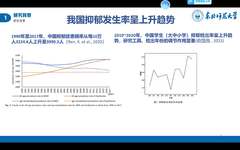
Depression can take a toll on life and in extreme cases can even lead to suicide. The existing literature reveals that the high incidence of depression may be the product of the process of modernity. However, previous studies have only emphasized the influence of negative life events and negative cognition, which is insufficient to explain the high incidence of depression with the development of years. Based on this, this study aims to investigate the effect of intervention with individual modernity characteristics on reducing the depression level of college students on the basis of traditional intervention focusing only on coping with negative events and negative thinking.
Methods
A 2×3 two-factor intersubject design was used. Independent variable 1 was the type of intervention training, and there were two levels of intervention group and control group. Independent variable 2 is the type of school level, which has three levels: key undergraduate, ordinary undergraduate and junior college. The dependent variables were depression, hopelessness and life satisfaction.
The contents of the intervention were problem solving training for negative events, cognitive reconstruction training for negative cognition, and adjustment training for materialism, individualism, class mobility anxiety and meaninglessness. The intervention lasted for 8 weeks and was divided into four stages: pre-test, intervention stage and 8 consecutive tests, immediate post-test, and delayed post-test (Figure 1).
Results & Discussion
149 participants were included in the study, 80 in the intervention group and 69 in the control group, with a mean age of 18.58 years and an age range of 16-23 years. Repeated measurement analysis of variance showed that depression and hopelessness were significantly different in the intervention group but not in the control group for the three measurements. There were no significant differences in the pre-test between the intervention group and the control group, and significant differences in the post-test and delayed post-test, showing similar differences among the three school-level types (Table 1).
Mixed model analysis showed that eight measures of life satisfaction grew significantly higher in the intervention group (β=0.523, p < 0.001) and not significantly higher in the control group. The key undergraduate group (β=0.523, p < 0.001), ordinary undergraduate group (β=0.523, p < 0.001), and junior college group (β=0.523, p < 0.001) showed a consistent trend (Figure 2-5).
Conclusions
The intervention of comprehensive coping, cognition and adjustment of individual modernity characteristics has remarkable effect on improving depression of college students, and it is suitable for universities at different levels.
Depression can take a toll on life and in extreme cases can even lead to suicide. The existing literature reveals that the high incidence of depression may be the product of the process of modernity. However, previous studies have only emphasized the influence of negative life events and negative cognition, which is insufficient to explain the high incidence of depression with the development of years. Based on this, this study aims to investigate the effect of intervention with individual modernity characteristics on reducing the depression level of college students on the basis of traditional intervention focusing only on coping with negative events and negative thinking.
Methods
A 2×3 two-factor intersubject design was used. Independent variable 1 was the type of intervention training, and there were two levels of intervention group and control group. Independent variable 2 is the type of school level, which has three levels: key undergraduate, ordinary undergraduate and junior college. The dependent variables were depression, hopelessness and life satisfaction.
The contents of the intervention were problem solving training for negative events, cognitive reconstruction training for negative cognition, and adjustment training for materialism, individualism, class mobility anxiety and meaninglessness. The intervention lasted for 8 weeks and was divided into four stages: pre-test, intervention stage and 8 consecutive tests, immediate post-test, and delayed post-test (Figure 1).
Results & Discussion
149 participants were included in the study, 80 in the intervention group and 69 in the control group, with a mean age of 18.58 years and an age range of 16-23 years. Repeated measurement analysis of variance showed that depression and hopelessness were significantly different in the intervention group but not in the control group for the three measurements. There were no significant differences in the pre-test between the intervention group and the control group, and significant differences in the post-test and delayed post-test, showing similar differences among the three school-level types (Table 1).
Mixed model analysis showed that eight measures of life satisfaction grew significantly higher in the intervention group (β=0.523, p < 0.001) and not significantly higher in the control group. The key undergraduate group (β=0.523, p < 0.001), ordinary undergraduate group (β=0.523, p < 0.001), and junior college group (β=0.523, p < 0.001) showed a consistent trend (Figure 2-5).
Conclusions
The intervention of comprehensive coping, cognition and adjustment of individual modernity characteristics has remarkable effect on improving depression of college students, and it is suitable for universities at different levels.
Keywords
depress intervention modernity college
Speaker

于鑫
教育培训部主任 东北师范大学Submission Author
All Comments
Important Date
-
Conference Date
Jan 10
2025
toJan 11
2025
-
Jan 08 2025
Draft paper submission deadline
-
Jan 14 2025
Registration deadline
-
Jan 17 2025
Contribution Submission Deadline
Sponsored By
天津大学
Contact Information
Previous Conferences
-
2021-11-04 China 线上会议
2021 China International Conference on Suicidology

Submit Comment