Presentation Details
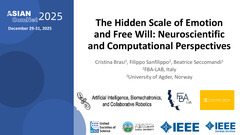
The Hidden Scale of Emotion and Free Will: Neuroscientific and Computational Perspectives
ID:1
View Protection:ATTENDEE
Updated Time:2025-12-24 16:43:07
Hits:628
Online
Start Time:2025-12-30 14:15(Asia/Amman)
Duration:15min
Session:S9 Track 5: Emerging Trends of AI/ML »
Abstract
Recognizing emotional intensity is a complex task that exceeds the scientific and biometric recognition of micro-expressions. The methods used by AI, including changes in neurogenerative states, are not reliable in recognizing emotional intensity because, above all, they are unable to distinguish between a highly intense emotion and a simulated emotion, while humans have the innate predisposition to emotion recognition. In fact, this innate predisposition is a necessary component to develop the ability to discern emotional intensity, which is the result of a continuous synchronicity process started in the womb with the exposure to maternal emotional variations. Successively, this capacity improves with the interaction of nature and culture, where prejudice, stereotypes, socio-cultural aspects and gender have an impact on emotional evolution. Finally, the assessment of intensity is closely linked to individual parameters such as personal history, coping responses, personality traits, and other individual factors. This study integrates the perspective of neuroscience with methods used in artificial intelligence for facial micro-expressions recognition and biometric elements. The mechanisms involved in the modulation of emotional responses are integrated here with neurophysiological evidence from profiling and computational approaches to emotion detection. Another element that is considered is free will, especially in the forensic field, highlighting how the incorrect use of AI risks compromising several fundamental rights. As highlighted in this study, human supervision of technicians specialized in profiling, is essential to ensure that purely biometric data is interpreted correctly. A multidisciplinary, human-centered approach is needed, combining robust physiological modeling, transparent algorithms, and strong ethical safeguards.
Keywords
emotional intensity recognition,emotion detection,AI facial recognition
Speaker

Cristina Brasi
Psychologist Crimino FBA-LAB Filippo Sanfilippo
Professor (Full) at University University of AgderSubmission Author
All Comments
Important Date
-
Conference Date
Dec 29
2025
toDec 31
2025
-
Dec 20 2025
Draft paper submission deadline
-
Dec 31 2025
Contribution Submission Deadline
-
Dec 31 2025
Registration deadline
Sponsored By
United Societies of Science
Organized By
Zarqa University
Contact Information
- Miss AsianComNet
- as******@usssociety.org
Previous Conferences
-
2024-10-24 Thailand Bangkok
2024 Asian Conference on Communication and Networks

Submit Comment