Presentation Details
华南地区重力波耦合带状对流典型天气个例的实际可预报性和不确定性研究
ID:96
View Protection:ATTENDEE
Updated Time:2026-07-31 21:51:51 Hits:0
Poster Presentation
Start Time:Pending(Asia/Shanghai)
Duration:Pending
Session:No Session »
Presentation File
Attachment File
Tips: Only the registered participant can access the file. Please sign in first.
Abstract
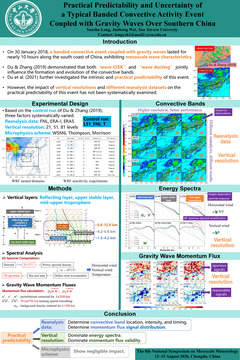
Understanding the practical predictability of mesoscale convective systems, defined as the forecast skill achievable under realistic initial and boundary conditions, is fundamental to improving numerical weather prediction. This study investigates the practical predictability and uncertainty of a wave-convection coupled banded event lasting nearly 10 hours over southern China on 30 January 2018. Using the Advanced Research Weather Research and Forecasting model (WRF-ARW), we perform a suite of sensitivity experiments by systematically varying three key factors, including initial and boundary conditions (NCEP FNL, ECMWF ERA-Interim, and ERA5), vertical resolutions (21, 51, and 81 levels), and microphysics schemes (Thompson, WSM6 single-moment, and Morrison double-moment). The analysis focuses on convective band simulation results, energy spectral characteristics, and gravity wave momentum flux diagnosis.
Results indicate that the simulation of convective bands is jointly dominated by initial conditions and vertical resolution. The 81-level NCEP FNL configuration performs best, with the main convective bands situated over land and their northeastward propagation captured more faithfully than in the control run. For the mesoscale energy spectra, at the dominant horizontal wavelength of the observed bands (~40–50 km), vertical resolution serves as the dominant factor governing the spectral distribution, exhibiting clear layer dependence. The horizontal wind and temperature spectra approximately follow the −5/3 power law, whereas the vertical wind spectrum is flat with a peak near 10 km wavelength. Notably, spurious spectral amplification appears at low vertical resolution in the mid-upper troposphere. Furthermore, the representation of gravity wave momentum flux is highly sensitive to vertical resolution. Widespread spurious disturbance signals emerge at 21 levels, while at 51 and 81 levels the signals become reasonable and align well with the convective band distribution. In contrast, the choice of microphysics scheme has no appreciable impact across all simulation results. These findings highlight the critical roles of vertical resolution and initial conditions in the numerical simulation of mesoscale convective systems.
Reference:
Yansha Long and Junhong Wei, 2026: Practical predictability and uncertainty of a typical banded convective activity event coupled with gravity waves over southern China. B.S. thesis, School of Atmospheric Sciences, Sun Yat-sen University.
Results indicate that the simulation of convective bands is jointly dominated by initial conditions and vertical resolution. The 81-level NCEP FNL configuration performs best, with the main convective bands situated over land and their northeastward propagation captured more faithfully than in the control run. For the mesoscale energy spectra, at the dominant horizontal wavelength of the observed bands (~40–50 km), vertical resolution serves as the dominant factor governing the spectral distribution, exhibiting clear layer dependence. The horizontal wind and temperature spectra approximately follow the −5/3 power law, whereas the vertical wind spectrum is flat with a peak near 10 km wavelength. Notably, spurious spectral amplification appears at low vertical resolution in the mid-upper troposphere. Furthermore, the representation of gravity wave momentum flux is highly sensitive to vertical resolution. Widespread spurious disturbance signals emerge at 21 levels, while at 51 and 81 levels the signals become reasonable and align well with the convective band distribution. In contrast, the choice of microphysics scheme has no appreciable impact across all simulation results. These findings highlight the critical roles of vertical resolution and initial conditions in the numerical simulation of mesoscale convective systems.
Reference:
Yansha Long and Junhong Wei, 2026: Practical predictability and uncertainty of a typical banded convective activity event coupled with gravity waves over southern China. B.S. thesis, School of Atmospheric Sciences, Sun Yat-sen University.
Keywords
重力波,湿对流,中尺度,实际可预报性,能谱,重力波动量通量
Speaker

龙艳莎
学生 中山大学Submission Author
All Comments
Important Date
-
Conference Date
Aug 12
2026
toAug 15
2026
-
Aug 05 2026
Draft paper submission deadline
-
Aug 12 2026
Registration deadline
Sponsored By
成都信息工程大学
Organized By
成都信息工程大学
Contact Information
Previous Conferences
-
2025-08-15 China 大同市
第七届全国中尺度气象学研讨会 -
2021-01-14 China 南京市
第三届全国中尺度气象学论坛

Submit Comment