Presentation Details
Use Machine Learning Based Smart Sampling to Improve System Level Testing Efficiency
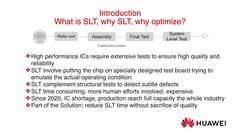
Start Time:2021-08-19 20:00(Asia/Shanghai)
Duration:20min
Session:RS Regular Paper Session »
Tips: Only the registered participant can access the file. Please sign in first.
Abstract
Keywords
Speaker
Chenwei Liu
Huawei Technology Co., Ltd.Mr. Chenwei Liu is currently an AI scientist at Hisilicon Semiconductor Ltd. He is actively engaging machine learning and deep learning techniques to help improve semiconductor manufacturing and testing effeciencies. His efforts also include wafer map classification, automatic defect detection and classification based on innovative computer vision algorithms. Before joining Huawei, he worked more than 15 years in the united states as data science professionals in the medical research, IT consulting, memory chip manufacturing and telecommunication service industries.
All Comments
Important Date
-
Conference Date
Aug 18
2021
toAug 20
2021
-
May 10 2021
Draft paper submission deadline
-
Aug 16 2021
Early Bird Registration
-
Aug 19 2021
Contribution Submission Deadline
-
Aug 20 2021
Registration deadline
Sponsored By
Tongji University
Chinese Computer Federation
Organized By
Contact Information
- Prof. Zhang Ying
- yi******@tongji.edu.cn
Previous Conferences
-
2022-08-24 Taiwan, China Taipei
2022 IEEE International Test Conference in Asia -
2019-09-03 Japan Tokyo
2019 IEEE International Test Conference in Asia -
2018-08-15 China
2018 IEEE International Test Conference in Asia -
2017-09-13 Taiwan, China Taipei
2017 IEEE International Test Conference in Asia -
2014-11-10 China 杭州市
IEEE International Test Conference in Asia

Submit Comment