Presentation Details
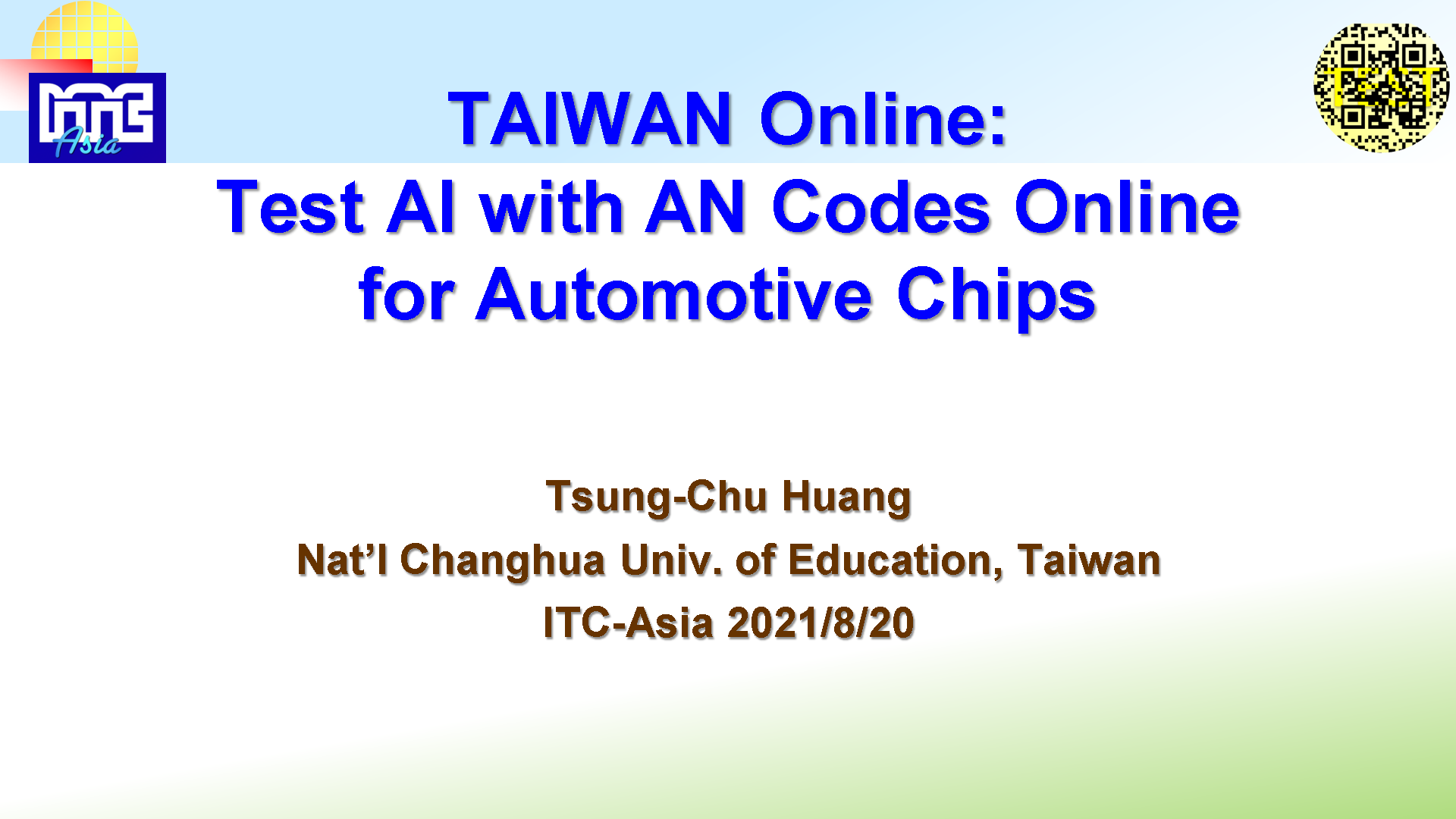
TAIWAN Online: Test AI with AN Codes Online for Automotive Chips
Start Time:2021-08-20 21:05(Asia/Shanghai)
Duration:20min
Session:SS Special Session »
Tips: Only the registered participant can access the file. Please sign in first.
Abstract
Keywords
Speaker

Tsung-Chu Huang
Professor National Changhua University of EducationHUANG, Tsung-Chu received his BS degree in Electrical Engineering Department of the National Taiwan University in 1986. He received his MS in EECE from the University of Southern California, US in 1991, and PhD in EE from the National Cheng Kung University, Taiwan in 2002. He is currently a tenured professor of Electronics Engineering Department at the National Changhua University of Education, Taiwan. Professor Huang is an honored member of the Phi-Tau-Phi Scholastic Honor Society. He is also a member of IEEE Computer Society, a tenured member of Taiwan IC Design Society and an associate editor of IET Electronics Letters. His interests include design-for-reliability and neural network acceleration.
All Comments
Important Date
-
Conference Date
Aug 18
2021
toAug 20
2021
-
May 10 2021
Draft paper submission deadline
-
Aug 16 2021
Early Bird Registration
-
Aug 19 2021
Contribution Submission Deadline
-
Aug 20 2021
Registration deadline
Sponsored By
Tongji University
Chinese Computer Federation
Organized By
Contact Information
- Prof. Zhang Ying
- yi******@tongji.edu.cn
Previous Conferences
-
2022-08-24 Taiwan, China Taipei
2022 IEEE International Test Conference in Asia -
2019-09-03 Japan Tokyo
2019 IEEE International Test Conference in Asia -
2018-08-15 China
2018 IEEE International Test Conference in Asia -
2017-09-13 Taiwan, China Taipei
2017 IEEE International Test Conference in Asia -
2014-11-10 China 杭州市
IEEE International Test Conference in Asia

Submit Comment